

RYA Ocean Course 26’
DEPARTURE
It felt I was not flying to a destination so much as flying to the beginning of a long-desired objective. To a boat once again, yes. But this time not a boat rigged to catch bottom fish, or crab; that was long ago. I was not returning to a 300 m container ship waiting for me behind impenetrable security resting under several hyperactive cranes, but to the 23m expedition sailing vessel Vinson of Antarctica. There was something about going to the Falklands, to a sailboat that made the trip seem like I was returning. Though I had never been to Port Stanley, and hadn’t voyaged on a sailboat for decades, I started life out as a sailor and I still “sail” as we call shipping out in the merchant marines.
My early days sailing were not fancy. Dad and I pressing his 17-foot O’Day Javelin into the wind tacking just before crashing into a dock or a point of land. As a teenager I worked as a deckhand for two years aboard the 51’ S&S yawl, Figaro IV; there was a season spent on a windjammer out of Camden, Maine. Seeking higher latitudes, seeking adventure, led not to more boats governed by wind but to platforms driven by diesel engines, hulls designed to harvest the sea. Somehow I ended up working in the Antarctic and then I went to college to become a teacher. Mine has not been a straight path. At 53, after accumulating ten years of experience aboard unlimited tonnage merchant ships I passed the U.S.C.G. examinations for officer in charge of a navigational watch. At 54 I wondered: am I still interested in truly sailing? I cannot remember how I first learned of Skip Novak and Pelagic Expeditions; it has been over ten years of dreaming. A year didn’t go by without me expressing an interest in signing aboard the RYA Celestial Navigation Delivery.
Standing in line in Punta Arenas, waiting to reboard the same flight from Santiago to Punta Arenas that would carry us to Mount Pleasant Falklands, a man asked me my reason for traveling to such an unusual destination.
“I’m going sailing!” I told him.
“It’s a terribly windy place to sail.” He replied. I nodded.
“And to study celestial navigation on a long passage to Cape Town.” I added hoping to calm his nerves; windy places don’t offend me.
“Well then, I wish you many clear days and very bright stars.”
The line suddenly started moving. We shook hands goodbye. I moved closer to my objective.
TRANSFORMATION
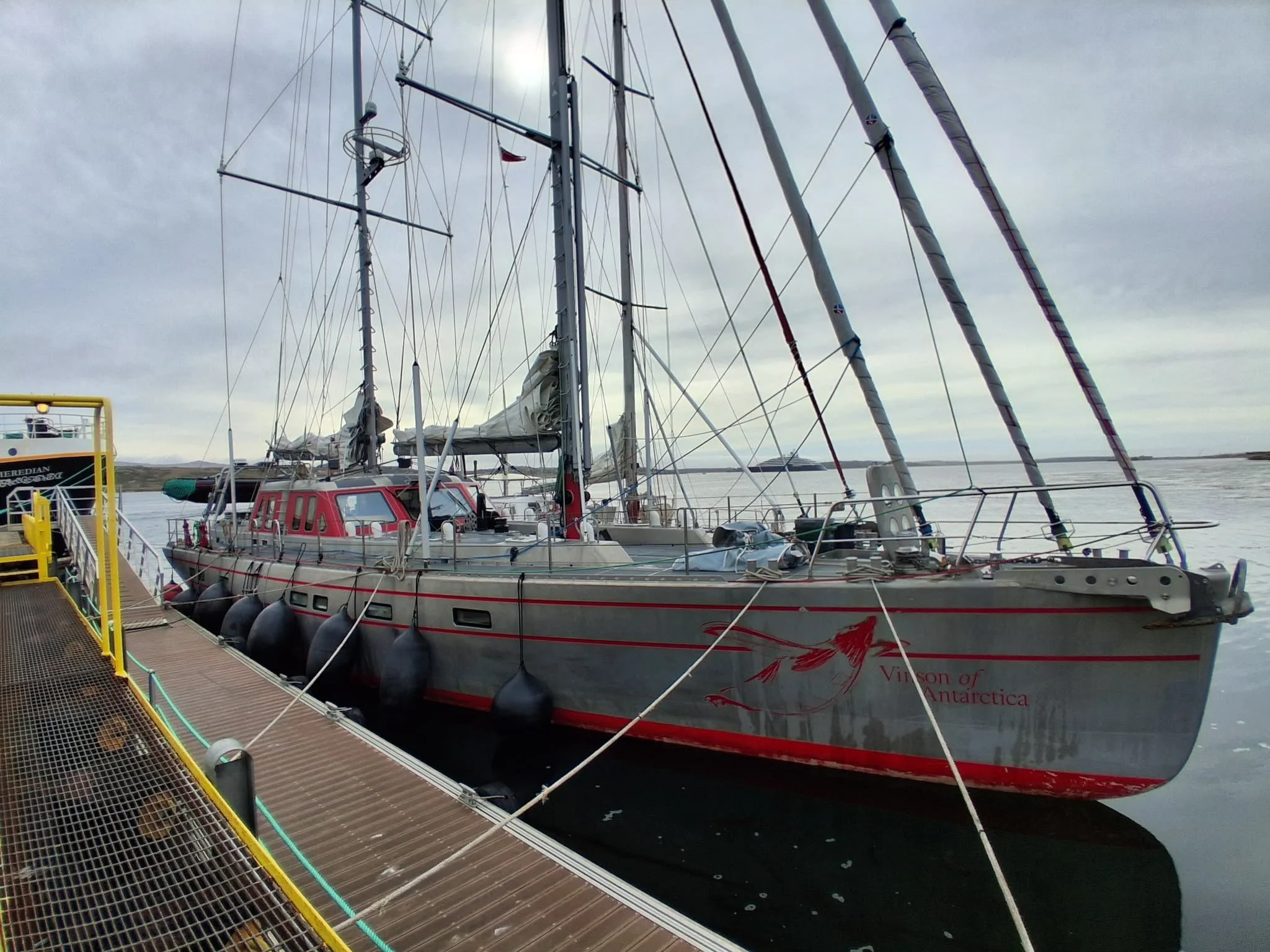
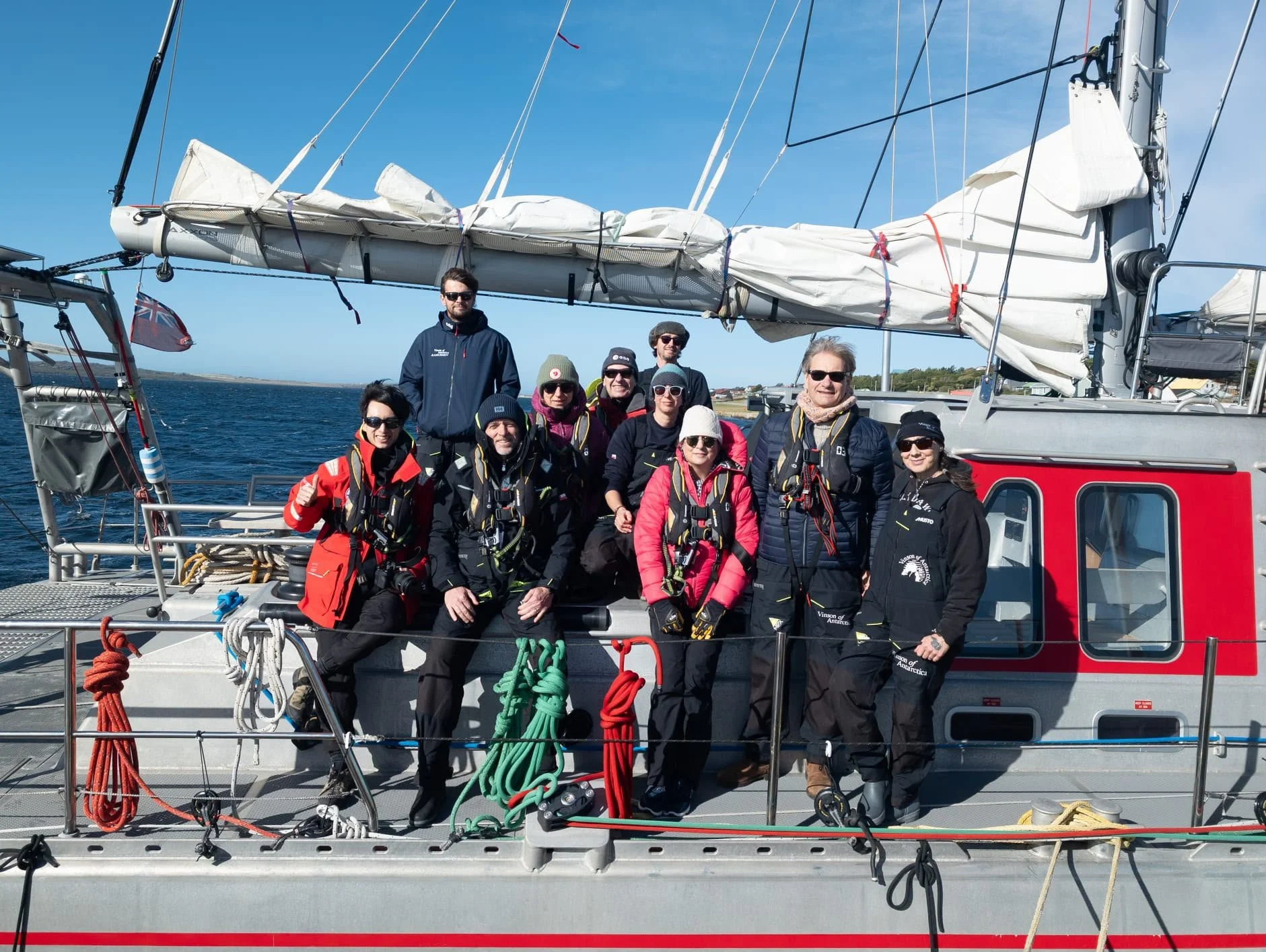
It is always a relief to lay eyes upon the vessel that will carry your life from one place to another. The Vinson was moored at a fringe finger dock at the east end of town. She was an impressive sight with her red striped masts and serious repose; the kind of boat that seems to read your mind. We were seven students standing there in the breeze each thinking our own thoughts. The three crew: Captain Paul, First Mate Bee, and Deckhand Wesley (who deserves to at least be called “third mate”—though I realize that is not how yachting certifications are structured) greeted us beside the honest Land Rover. We tossed our kits aboard. After a brief introduction we were assigned a number to match up with our life jackets, clothes hooks and chores and then moved into our cabins. My cabin mate was the kind of person you feel you have known and trusted all your life. She is an active sailor used to smaller boats; she is kind soul with a sense of humility. And humor. To her the cabin was a luxury condo. To me, used to the enormous space aboard merchant ships (double bed, desk, private head with shower, reading chair) it was a flash back to a more modest fishing boat. I wondered for the first time: what have I done? I remembered my passion for the sextant, navigation, the transparent lucidity of the ocean and my hope to find Tristan da Cunha in a gentle swell. I turned to focusing on sleep. Somebody flushed the toilet. The macerator pump began its wheezing cycle.
“It sounds like someone is strangling a sea mammal!” My cabin mate cried out. We erupted into a fit of laughter that was not conducive to rest. I wrote in my journal: the V of A is perhaps one of the world’s best examples of machine meets elegance. Everything about her has been predicated upon the importance of maximizing efficiency and function never turning a blind eye to the base fact she is a high latitude performance ship capable of safely sailing the south Atlantic.
IN PORT
School began right away the next morning at 0800. Day one was held aboard in the cozy main saloon. We are settling in. Day two, three, and four we walked the welcomed twenty-minute hike up the hill to the Army barracks. We peered through the sextants standing in the gravel drive. The horizon just above the bay over a line of wind sculpted evergreens. Cypress? Yew? The crew brought hot soup and pickle relish sandwiches with cheese up for lunch in the Land Rover. We ate too many biscuits and passed our assessments. In what time we could steal between school and sunset, we visited the store, the post office; admired the cathedral. I went for a few runs in the rain. Wished I could stay longer because Port Stanley is so charming and mysterious.
On day five we went over star reductions aboard the boat. Capt. Paul continued to work down the impressive safety orientation list. We were due to sail Saturday afternoon. Just after lunch on Friday, Vinson’s sistership the Amundsen let go her lines from our port side. She motored away, her deck full of people hauling in fenders. “That’s us tomorrow,” I thought. The excitement palpable. The wind honking. Force five. The sun bright as lime juice on a cerulean sea. We donned our life jackets, familiarized ourselves with how and where to clip in our lifelines, simulated reefing the main and fore sails. It all felt strange because it felt like all I’ve ever known somehow. Yet there was much to be learned and who knows what the journey would feel like underway. The sextants were sitting idle, waiting in their wooden boxes like promises. That night the boat was surging and heaving at her lines, her crisp sails furled, the wind gusting, my brain thinking so many things: all my other boats’ names: Reverie, Kairos, Roseway, Savage, Rebel, Brenton Reef.
AT SEA
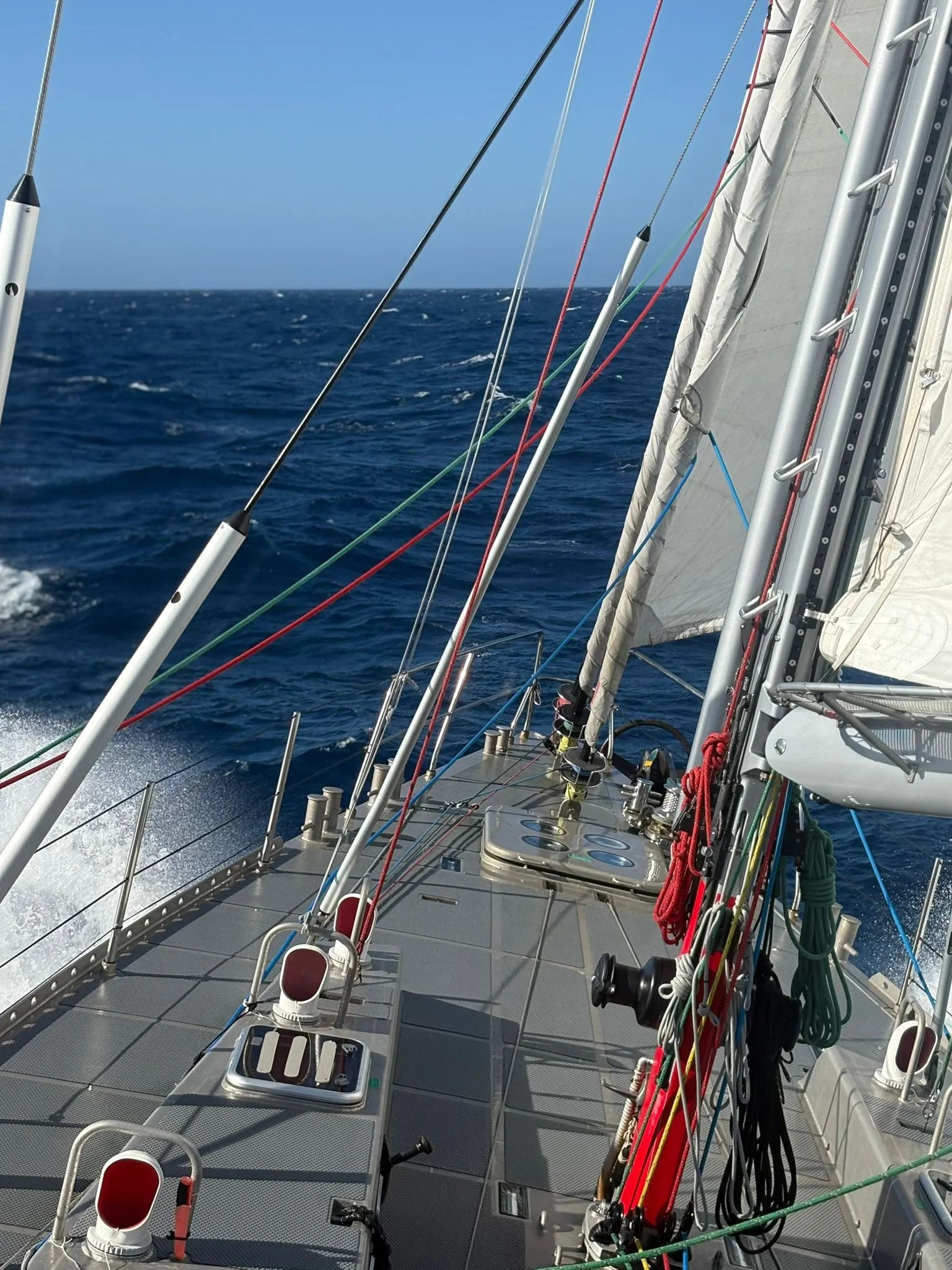
Leaving Port Stanley we motored through the Narrows. The freighter Frio Marathon was anchored off our starboard side. There was a fine sandy beach scribing a line just inside of her port rail as we ground the mainsail halyard up. It was cloudy with rainbows. We made a zig zag line through a gray-blue sea leaving behind us: flax, honeysuckle, crocosmia, lupine, rosemary, clothes lines, cats, dogs, ducks, the evening news. I wondered: is this a sport or a lifestyle? Watches had been set: 4 on/ 4 off for the 12 hours between 1800 and 0600 and then 6 on / 6 off for the 12 hours between 0600 and 1800. Night watches especially lend one the liberty to reflect. I hurtled over feelings like a jock at a track meet experiencing: Joy, exhaustion, hope, thrill, frustration, sorrow, satisfaction, contentment, doubt, epiphanies. Sailing, I determined, is about listening. And listening—not hearing—requires precision, patience and honesty. Especially with the self. You must listen to the weather systems & the wind & the sea state & the rigging & also to your gut. You must never miss an opportunity to bring the sun down to your horizon. Sure, sailing is about trying to get someplace across the expanse of water you are crossing, but why?
Routine has set in. I have learned how to use the intimidating pressure cooker. I have let loose some rotten yams. I can use a sextant successfully even as the ship performs capoeira. Because we are on watches my cabin mate and I no longer laugh simultaneously at the dying moans of the pump in the head. We laughed about it in passing though; our inside joke. We are all comfortable with one another. The food is hearty, delicious and never the same meal twice.
“I’m sorry!” someone says in the dark when they step on your toes.
“Not at all.”
“Cuppa tea?”
THE BUISINEES
Learning how to shoot the sun requires tenacity. People will tell you its easy. There’s a million YouTube videos out there made with good intention. They all fail. You need to get out on the rolling water and teach yourself how. By day four or five I learned that it all comes down to adjusting the Index Mirrors after capturing the sun. When you get your two suns in focus you’re in the money. Be careful here not to have too dark of a Horizon Mirror shade, however, as you lower it.
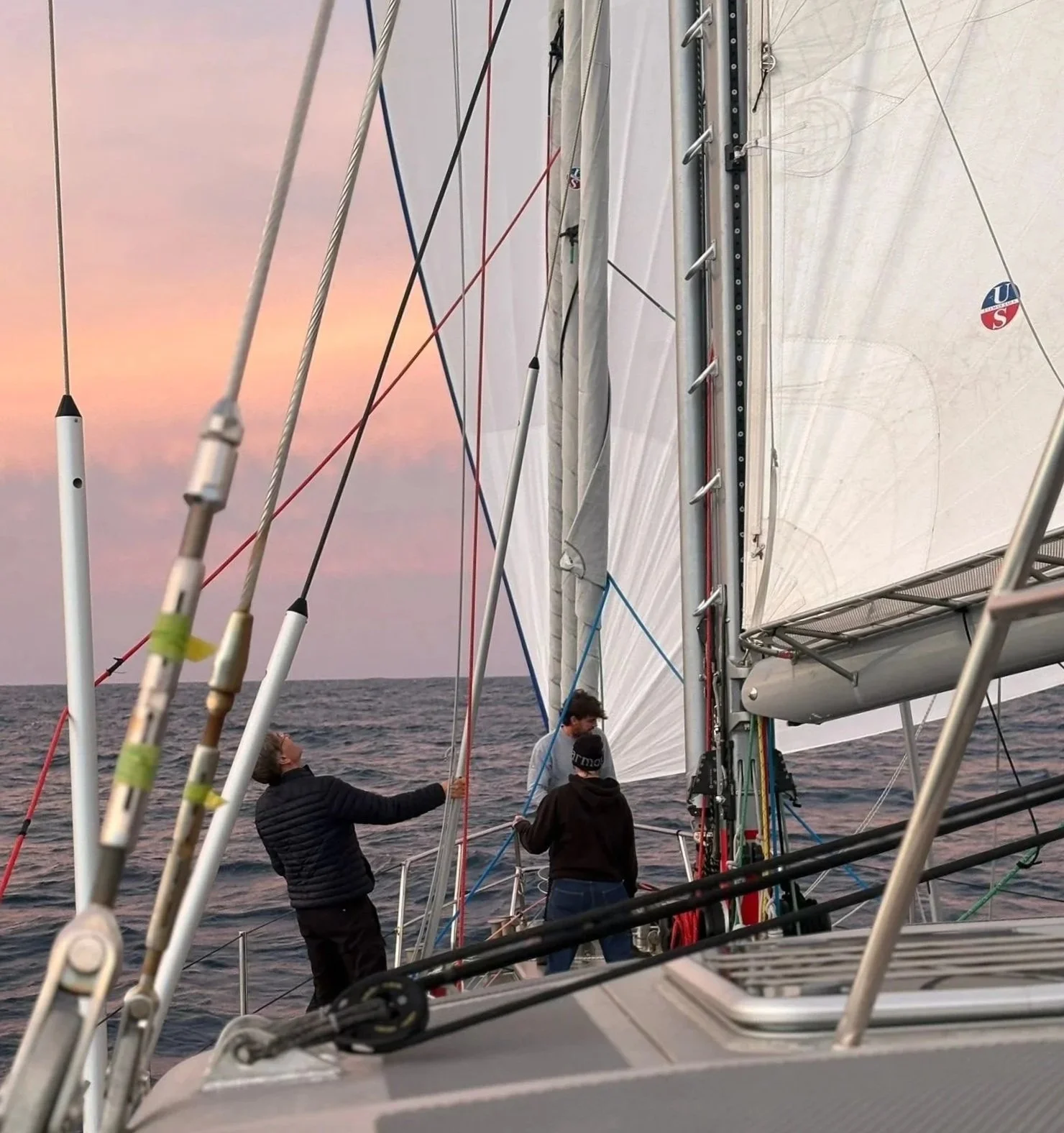
I have adapted to the feel of the boat. To slinging myself up into my bunk. I located my lee cloth and have made it fast: a bowline at the foot; a constrictor knot at the head. Our chores are lined up on the Pilot House bulkhead. I have quit stealing other people’s life jackets. I have decided that I would love ocean racing; I have become a winch hog.
“Ill grind!” I tell Wess or Bee as we head out in the rain to reef in the genoa or to shake a reef out of the mainsail.
In the cockpit I sat in the dark in my foulies, a hot beverage in my hands looking at the heavenly bodies. I wondered: will we put in at Edinburgh? By day we shot the sun. Reduced our sights. Plotted our fixes. Hourly we recorded the log:
“27 volts/ 87 % / six out of six” I would call up to the Pilot House from the bottom of the ladder to the main saloon. After dinner was weather. Always a parade of low-pressure systems powering us east, but now a high-pressure system was working helping to flatten out the swell around Tristan da Cunha. The air began to fill with optimism. Our fixes were good enough not to cause Paul too much concern; they could be better of course. We were in the thick of learning. Our consumption of digestives had begun to wane with the moon.
TRISTAN DA CUHNA 9 APRIL (Oh to be a “Station Fella”) *
I left home convinced I would not get ashore at Tristan. It was better not to be disappointed. I knew we would find it but could not bank on it finding us. At the end of the 2x4 watch Inaccessible Island appeared on the radar. We were motor sailing in calm winds. The surface of the ocean unbroken. By dawn, Tristan da Cunha stood off our starboard bow. A black top hat obscuring an otherwise unbroken horizon of pale light. We anchored. After radio formalities the 4X6 watch began inflating the Zodiac while we stole a nap. Before 1000 I was standing on the breakwater talking with Leon asking questions about teaching at the school (something had begun to call me back before I even stepped foot on the island).
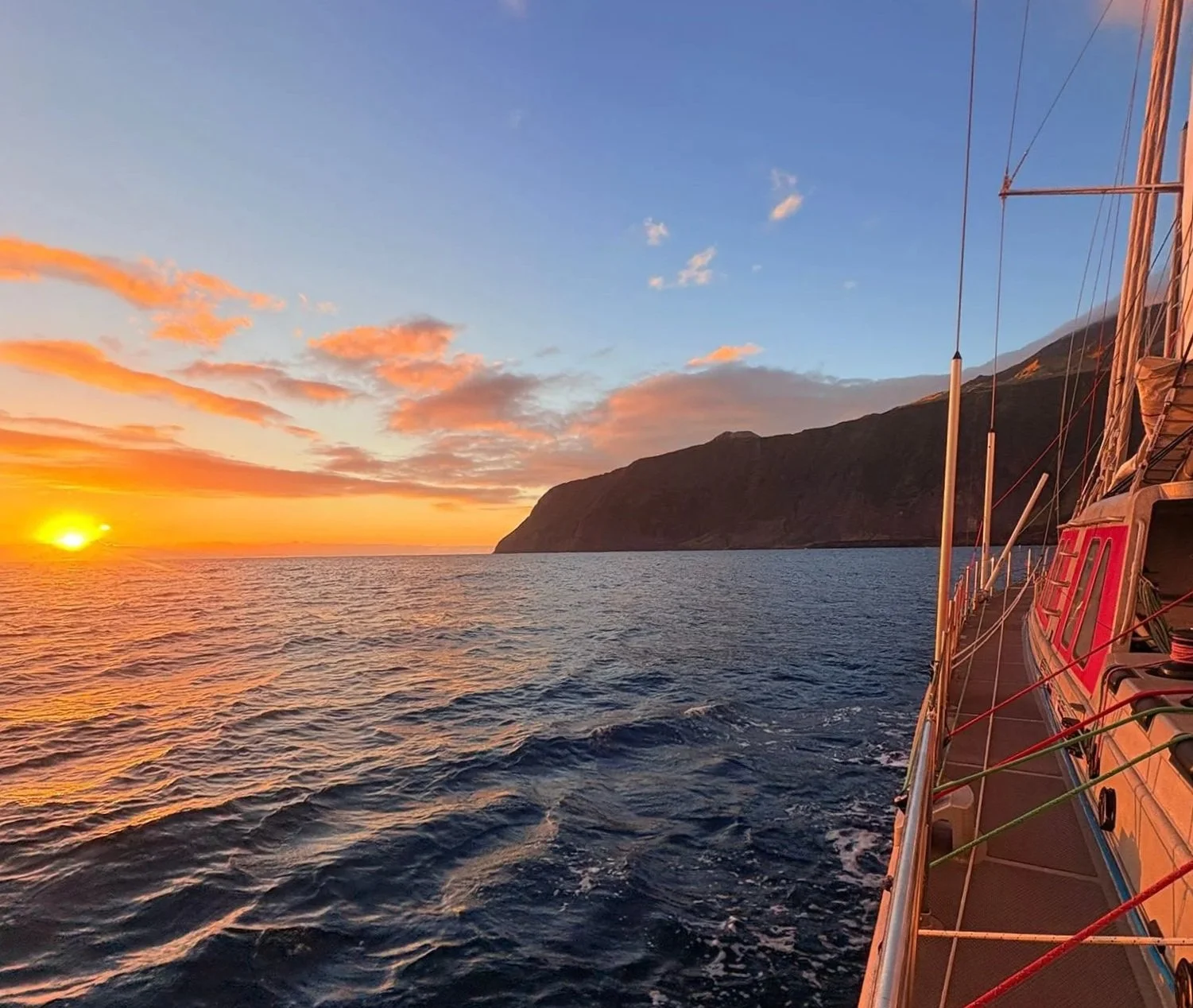
Tristan is part Aleutian Islands (Alaskan archipelago) part Tasmania. Mostly cliff. Verdant. The flat parts where the village grows is covered in hedges and giant New Zealand Flax. Bougainville spills over volcanic rock walls. It is alive with Skua Gulls and flossy cumulus clouds; black and white sheepdogs, cows, anxious foul. Potatoes mature in the rich volcanic soil. Crayfish lurk in the rocks around the archipelago; grace the flag, fill the belly. Yet Tristan da Cunha is by nature, and circumstantial history, very much its own place. It is further away from anything else on earth made of dirt where people live. Even time seems relatively distant…
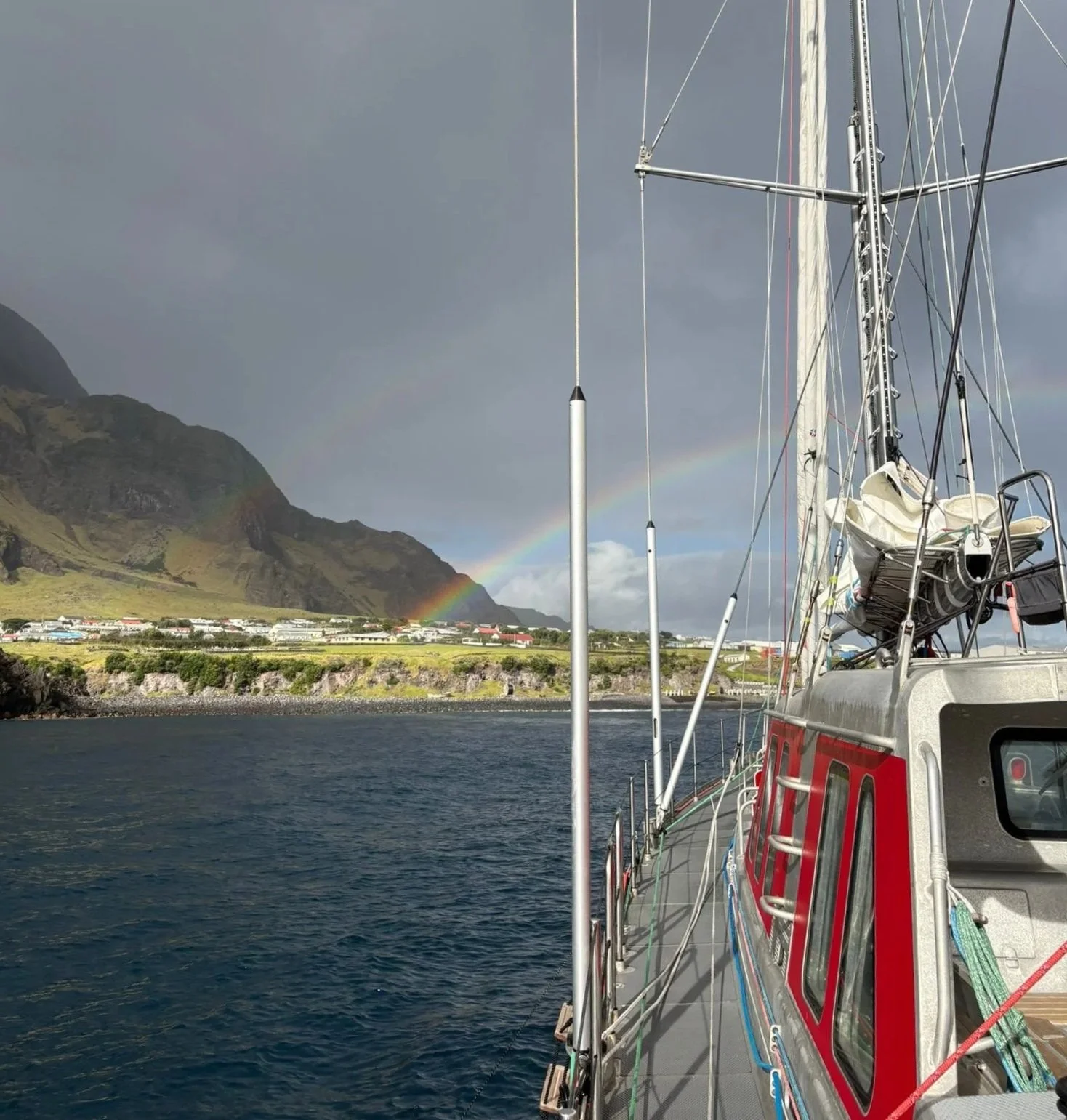
Paul took care of our passports while we perused the gift ship in the visitor’s center. I bought Love Socks for friends and a cardigan for my husband—by request (we had become fans of the island’s website and knew in advance about the sweaters and socks).
“Lobster rolls at noon on us.” Paul said giving us the time we needed to meet at Calshot Harbor in order to return to the boat, five hours hence.
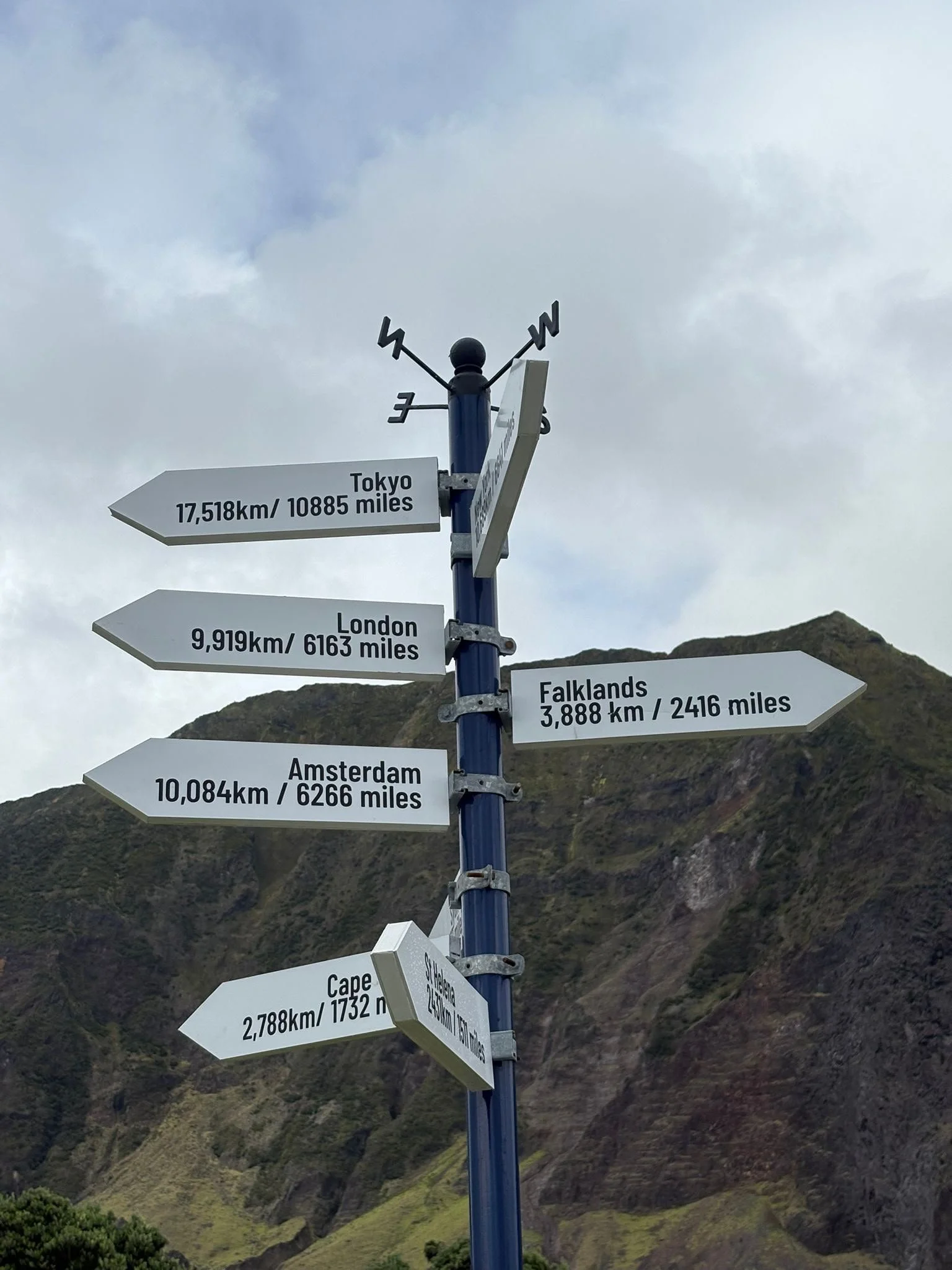
The sun came out. Again. I took off by foot towards the “Patches”, attempted a friendship with a feral herd of donkeys (failed), waved to the Tristinians herding sheep and ran out of flat ground to walk on when the jeep-track rolled down into the ocean. I took a nap in the sun just above the rocky beach with my face buried in the steaming grass shorn by centuries of ruminants. The earth smelled of salt rime, hay seed, rainwater, oakum and starlight. I woke up dreaming and walked to the other end of the island taking a stroll through the village where I talked with B. Swain outside the grocery store. I went up the hill past the school and the two cemeteries; I walked through the hardened lava fields thinking nothing but life. At a rise I looked at the Amundsen and the Vinson riding anchors just beyond the kelp bed.
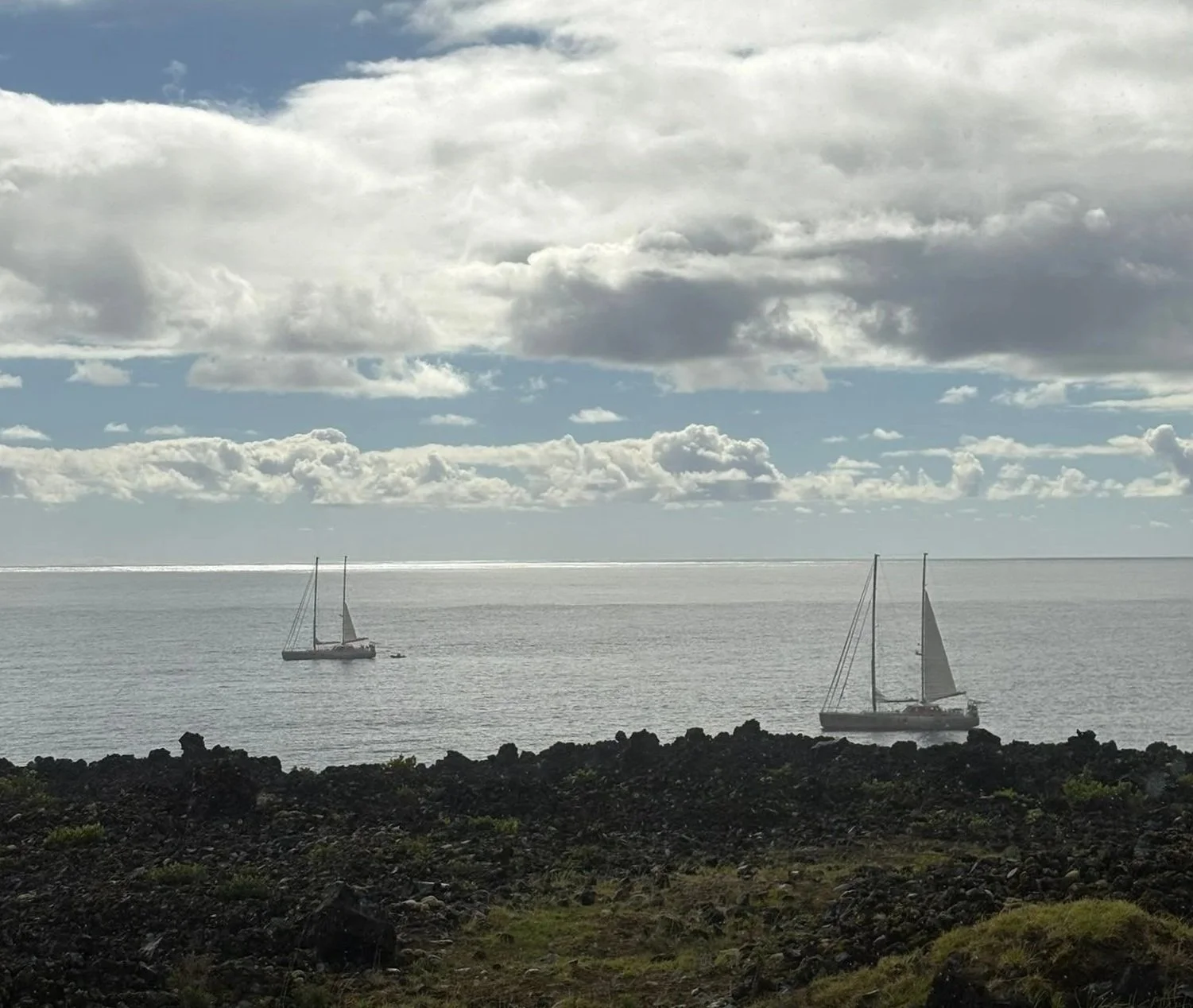
“We did it.” I told the small fleet. Then, turning my eyes back to the hard and admiring the bright, pink, lilies growing up from discarded refuse; steel boiler parts, a lost shoe, thought:
“I could live here.”
CAPE TOWN BOUND
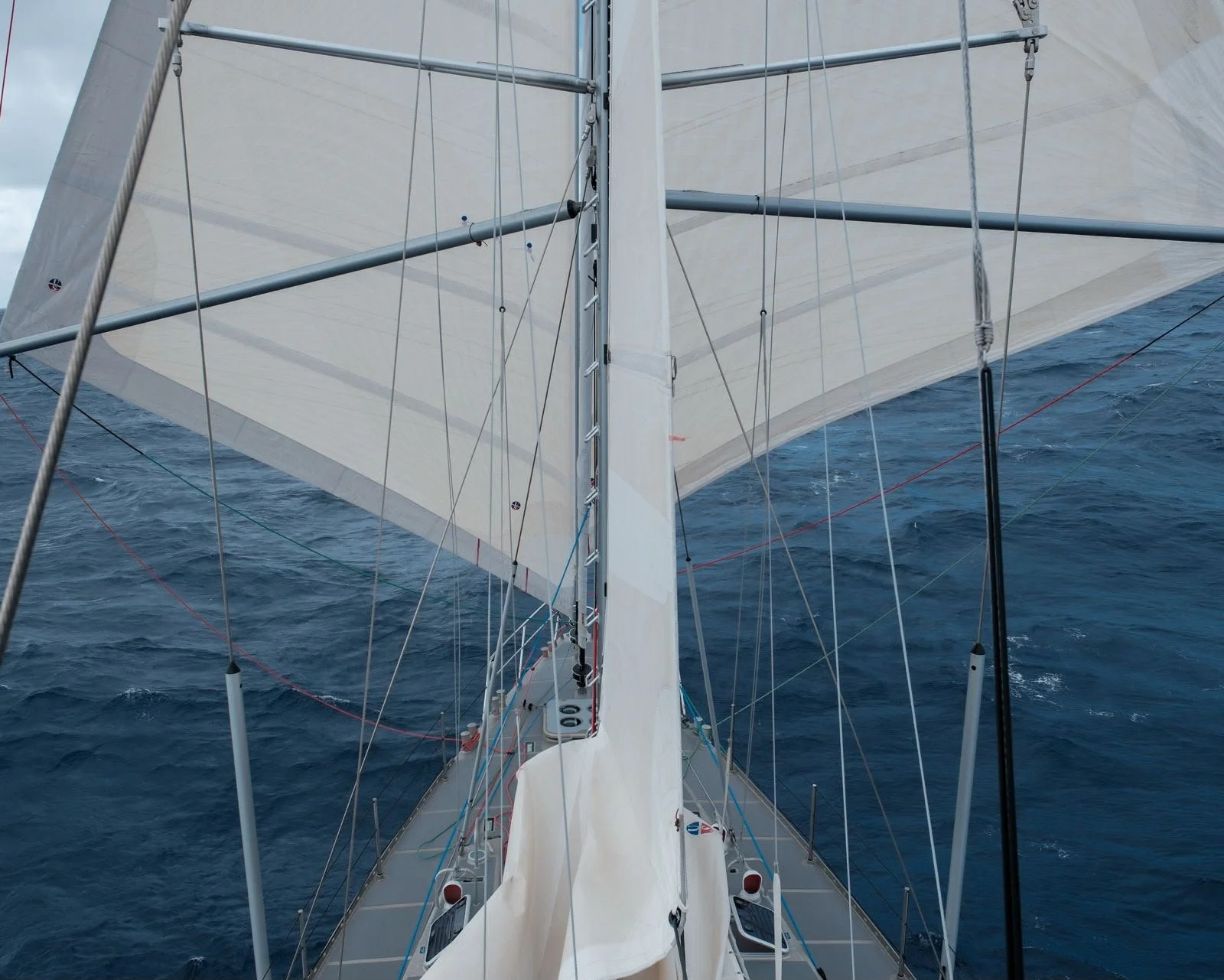
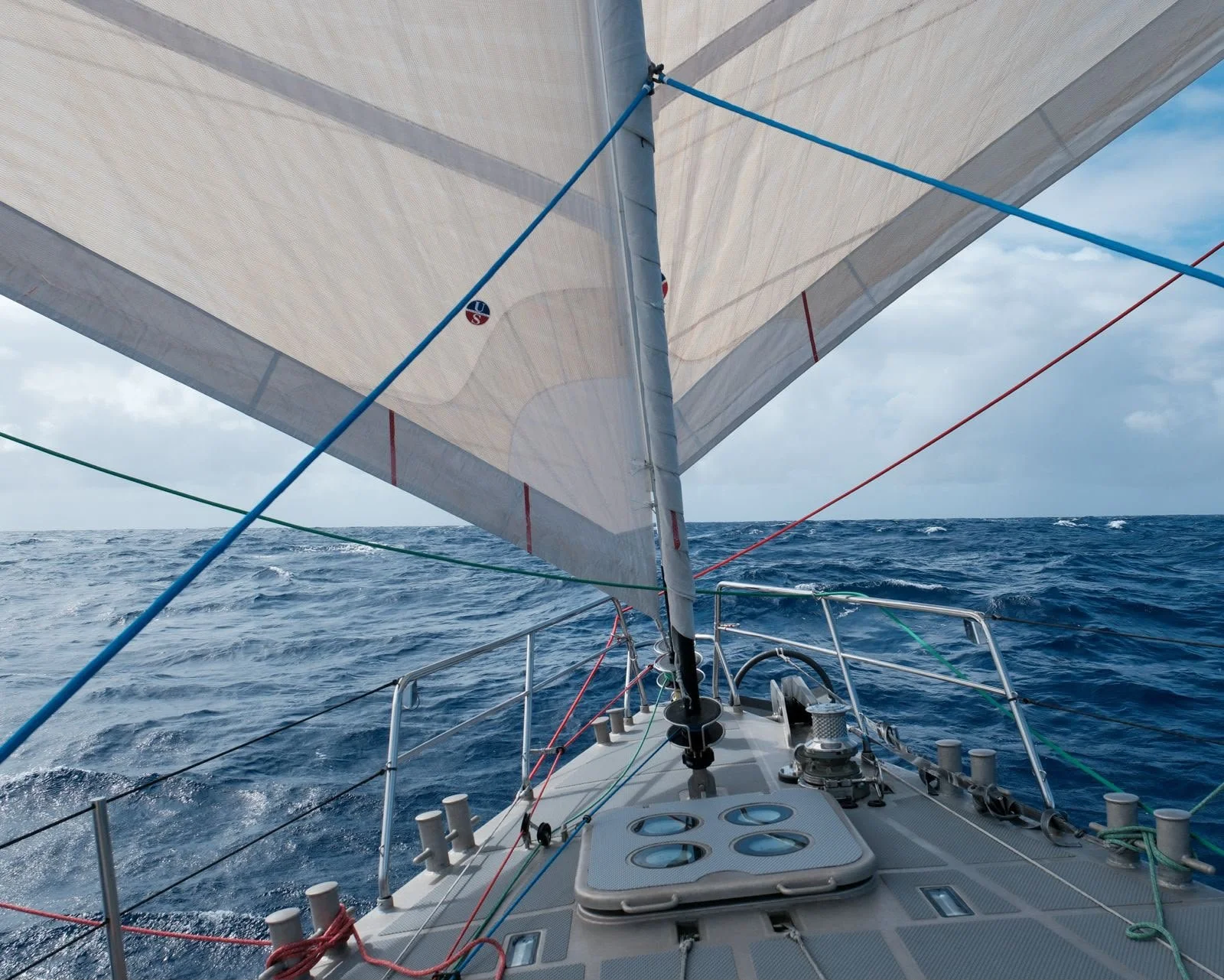
The rest of the passage seemed to pass in double time. Sure, the distance was less by almost a thousand miles, but the routine of our lives had become almost memorized, which really speeds things up. Watch, shoot, reduce your sight, plot, chores, eat, nap, journal, eat, repeat. For something different: laundry. Or a shower. For the most enthusiastic of us, shooting the night sky! Most of the produce we helped stow in Port Stanley had been consumed. Bee announced we were behind on our daily chocolate bar consumption. Everyone was wearing t-shirts and shorts on deck. We set the spinnaker one fine afternoon and a few days later Cape Town was found with the jib and genoa set wing on wing; a following sea surfing us down to stand off Table Bay exactly at the time we had planned. The Ubuntu Equality was steaming inbound. VTS radioed her to request she reduce speed. A mixture of feelings was felt— relief that the objective had been met and met with hard work and success and was now over; but also there was grief—grief that the real sailing was ending. My throat felt constricted. My heart surreal. There was an adrenalized sense of exhilaration mixed with a strong thirst for a beer followed by a nap. A paradox unfurled that I am still exploring.
TRANSFORMATION
The trip’s objective is over. I have been home for almost two weeks. I have not quit studying since I got back. I have always found navigation problems fun and I feel better about my future U.S.C.G celestial examination for Chief Mate than I ever anticipated. I have been writing about the trip and trying to explain it to friends who ask, “How was it?”
You cannot say how it was without giving a lot of context. In no ways can a trip like this be summed up.
The day after tomorrow, after disembarking from another plane, in another port, I will climb up the steep steps of the gangway to board the container ship, Perla del Caribe in Jacksonville, Florida. 40- and 53-foot shipping containers will be flying over my right shoulder like 25-ton petrels. I will meet the new captain, sign aboard, throw my sea bag in my stateroom, greet my fellow mates and begin learning the names of the crew. I wonder how the experience of the delivery will become realized as it matures in one of the best marinades such a once in a lifetime adventure could expect to meet?
I am still a sailor. As a merchant officer about to return to sea on a working ship, I look forward to picking up the sextant again. I will no doubt dream about the recently lost intimacy a sailor feels on a sailboat as I peer fifty feet down into the tourmaline scud of our Northern Atlantic route.
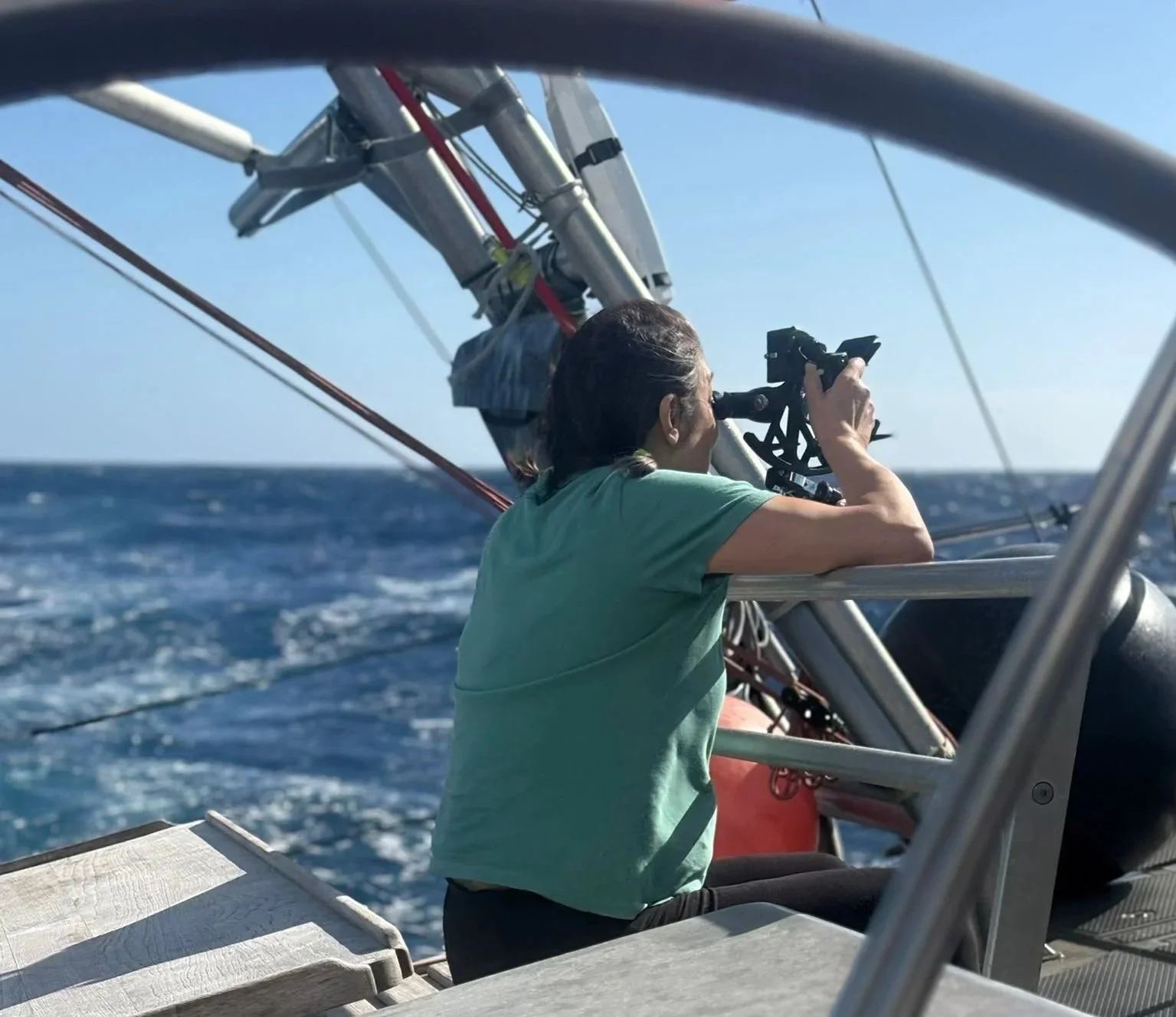
Despite learning how to solve complex celestial navigation problems for the U.S.C.G. license exam on paper, one does not actually need to hold a sextant to their eye on a pitching schooner in heavy seas. One does not have to find an island in the dark after nearly 3000 miles of working the wind. This is why I went. This is what I will always hold in my memory. It is an untouchable gift. A skill. An art. Time powered by the lungs of the planet’s weather systems; stars, new friends…
FINI: MERCI BEAUCOUP, CAPT PAUL, BEE, WES AND SKIP.
A “Station Fella” is the name Tristinians give to outsiders who come for a visit or a contractual job but who end up staying longer than expected; sometime for years.
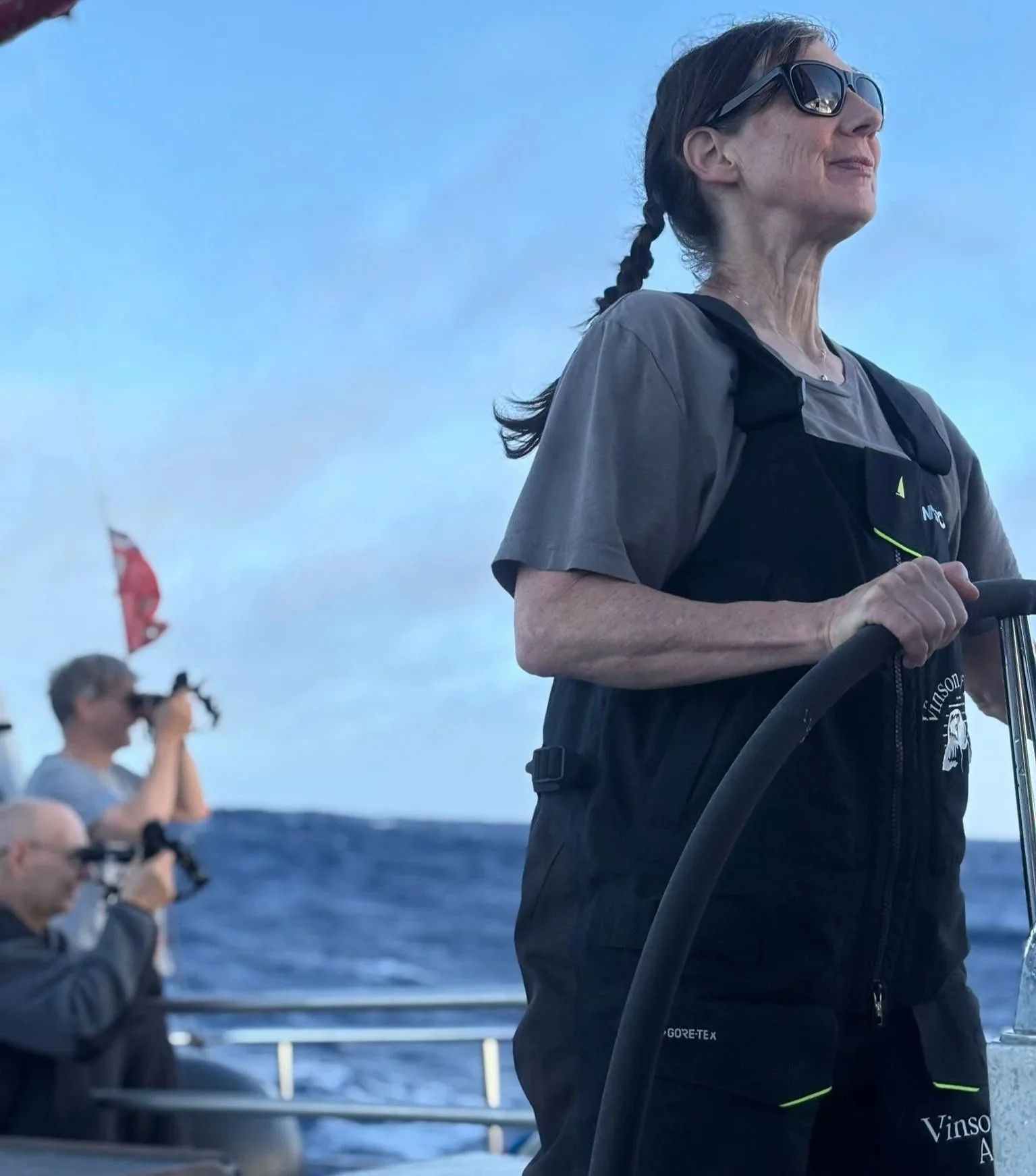
Shannon Zellerhoff
Yachtmaster Ocean Student
