

An expedition, forming a story, without an obvious plot. Well, the plot is something like this: we came, we saw, we took photos, we went. Oh, there was drama, an antagonistic power of katabatic winds and williwaws. Hard work and collaboration to keep everything running smoothly. But somehow the ups and downs were all absorbed by the island’s pillows of indulgent grace, a beauty in high-contrast. Gentoos carve highways up mountain foothills, climbing high to build their nests stone by stone, blade by grassblade. A hundred thousand King penguins bask in glacial streams under a tour de force sunrise, the two-tone zipper voices of parents returning from sea unique signatures to hungry chicks. Snowflakes speckle the jowls of fur seals roaring. Giant petrels trawl the tideline, jeering at the bloody bull elephant duels, whose rippling masses of blubber scatter scores of penguins.
Roses and gold at St Andrew’s Bay:
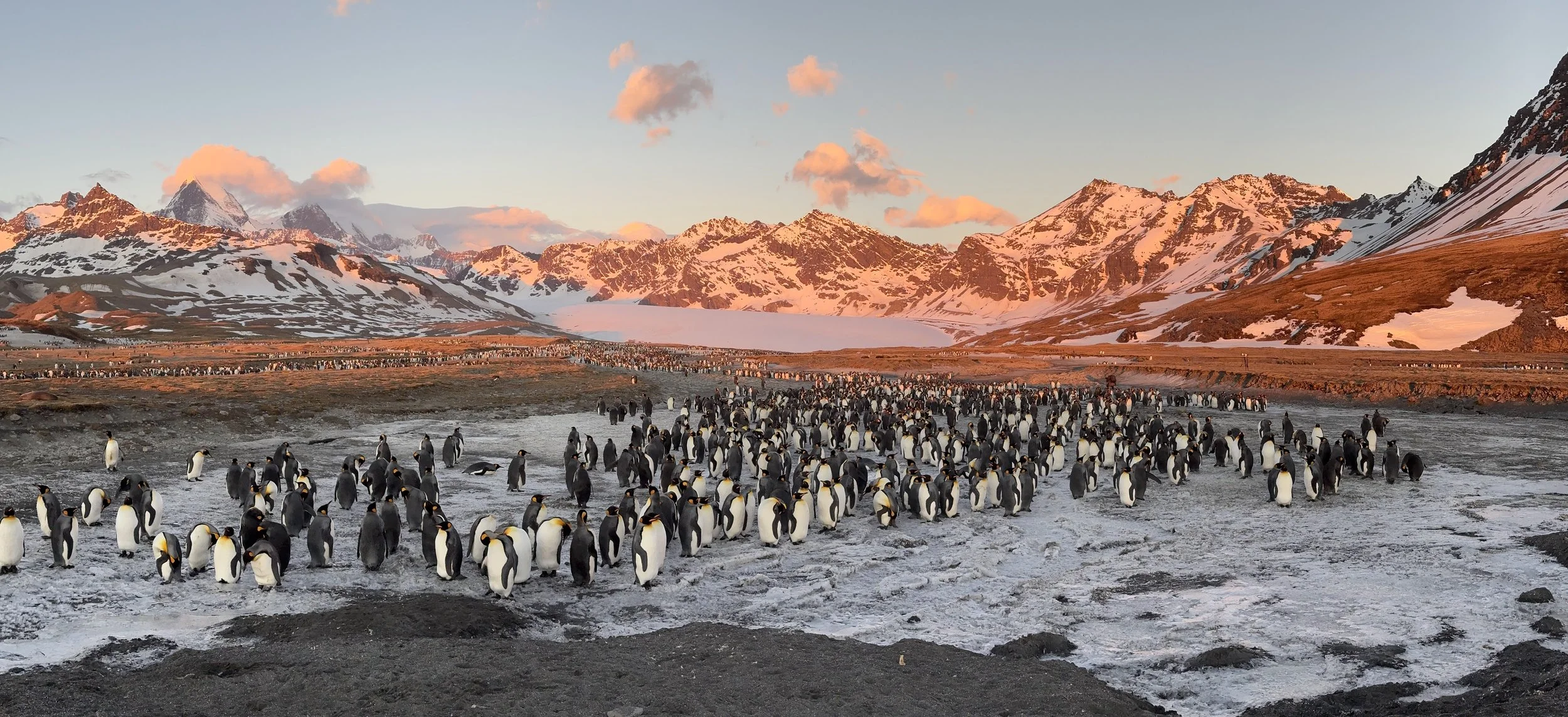
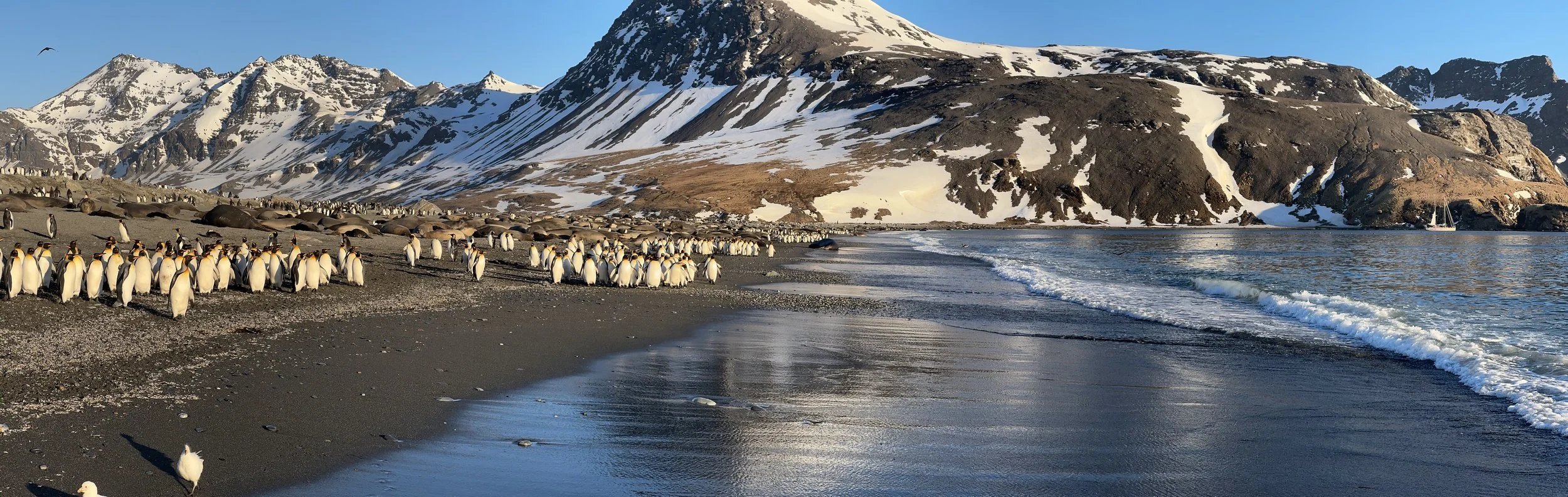
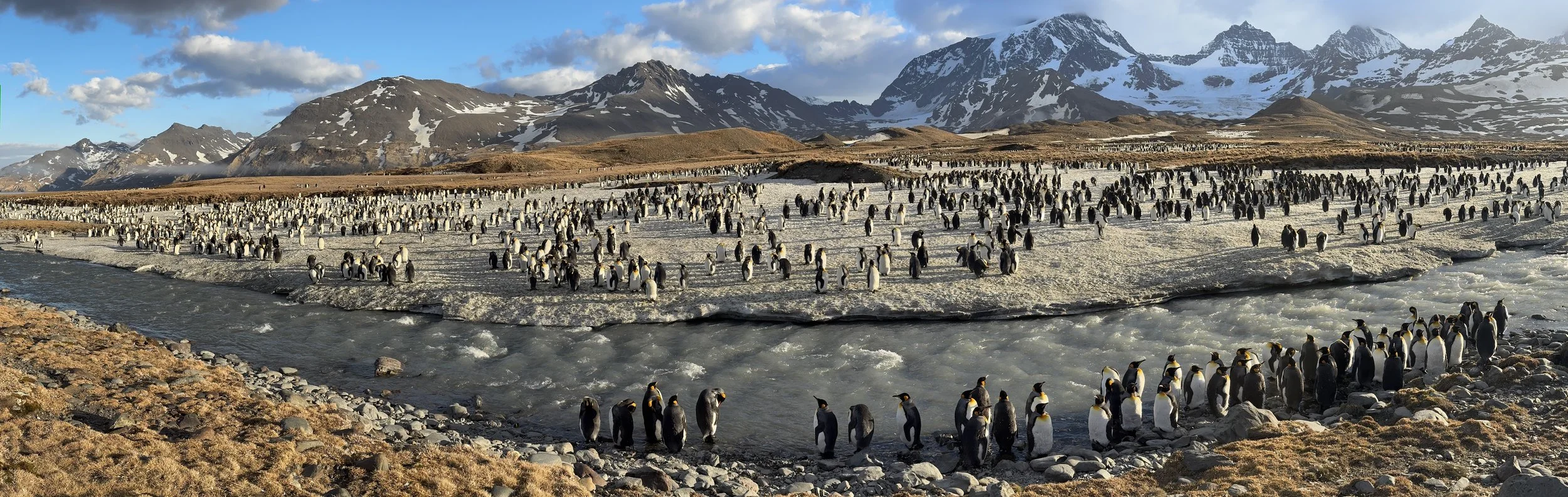
Witnessing South Georgia, there is a quality of eternity, beholding this theatre of demigods. The snowcaps and the storm-clouds wrestle one another like two skuas over a scrap of meat, as they have done for millennia untold. Even at a more human scale, South Georgia is in a push-and-pull of disruption and resurgence. In sixty years of whaling (~1904-1965), 175,000 whales were killed and processed (one plaque in Grytviken read 20 fin whales per day at the peak). Although I’d come mentally prepared, well familiar with the history of the region and the Moby-Dick vocabulary of industrial whaling, I was surprised to feel viscerally upset walking through the remains of that era. The flensing platforms, pressure cookers, and oil tanks alongside a quaint church and library. I recall Nan Brown’s vivid words on her experiences as one of three women at King Edward Point in the 1950s. She felt whaling was a necessary evil at the time, the price for progress. Only in recent years have whales been returning, feeling safe again, while we humans have yet to issue a formal interspecies apology.
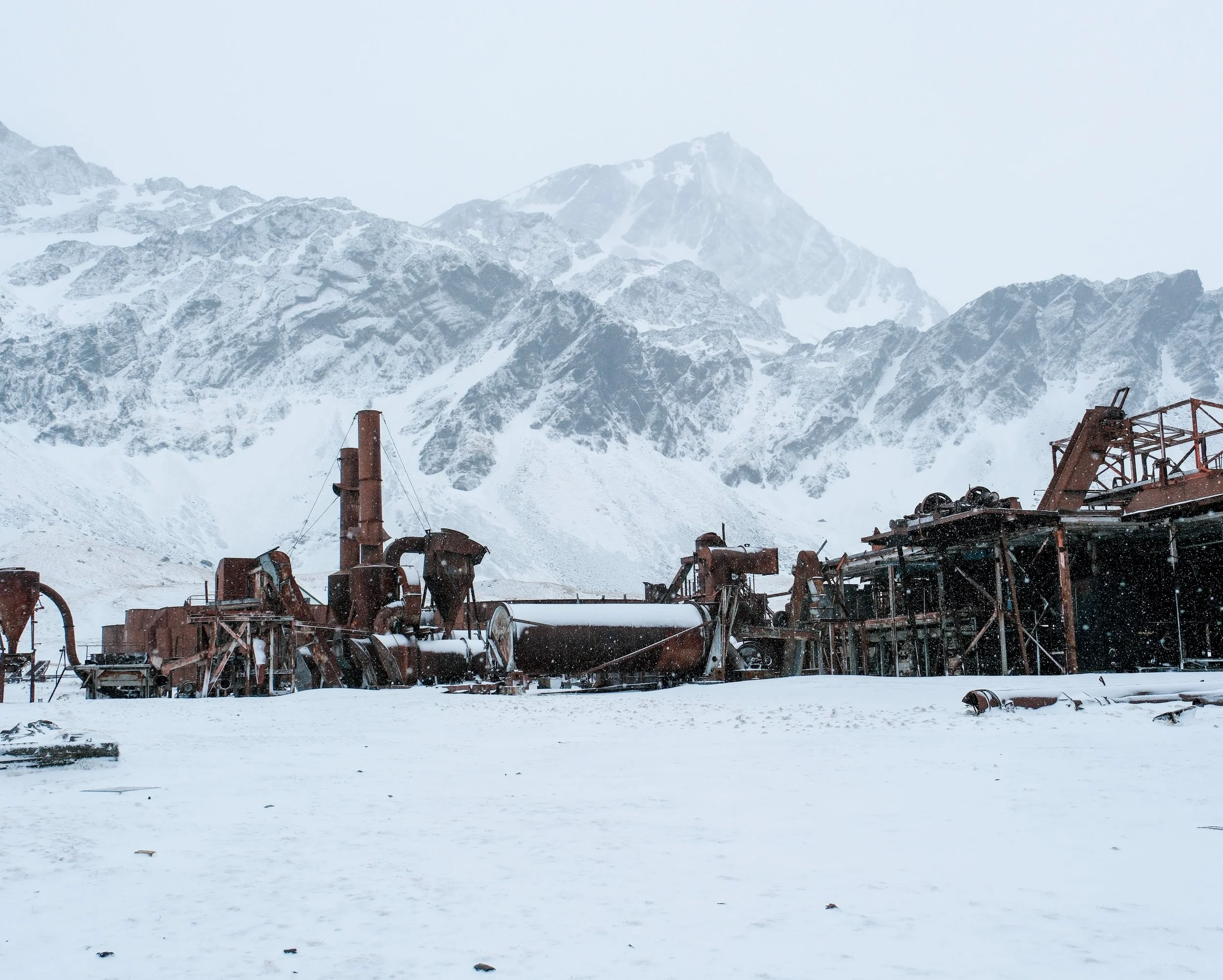
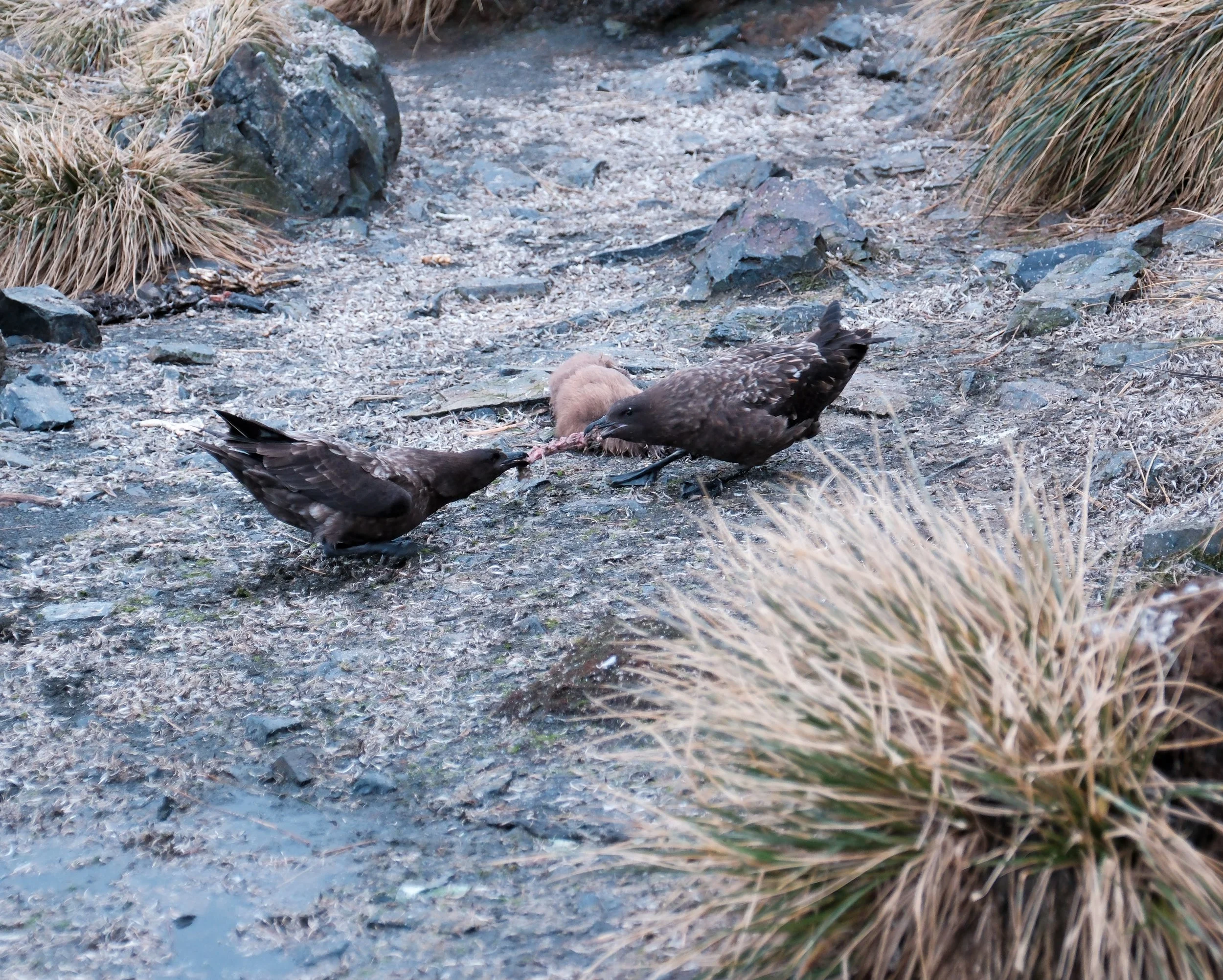
South Georgia’s conservation efforts have been tremendous. With the eradication of rats and Norwegian reindeer, songbirds and certain seabirds are rebounding. I was thrilled to encounter a pair of pipits dancing in the long grass. Strict biosecurity measures are helping to mitigate the spread of avian flu, which has taken a great toll on the seal populations. And yet, despite hands-on efforts, the glaciers are thawing at such a pace as to redefine “glacial”; and the pressures of warming waters and changing circulation are impacting the krill and food supply of key species. The eternity shows its edges.
For us on board Amundsen, our insignificant plot-line against an immense context can be told as a dialogue between two instruments: the Camera and the Barograph. What will the light be doing? Will we be able to land? Will the bay offer us shelter or funnel the wind? How long can we stay?
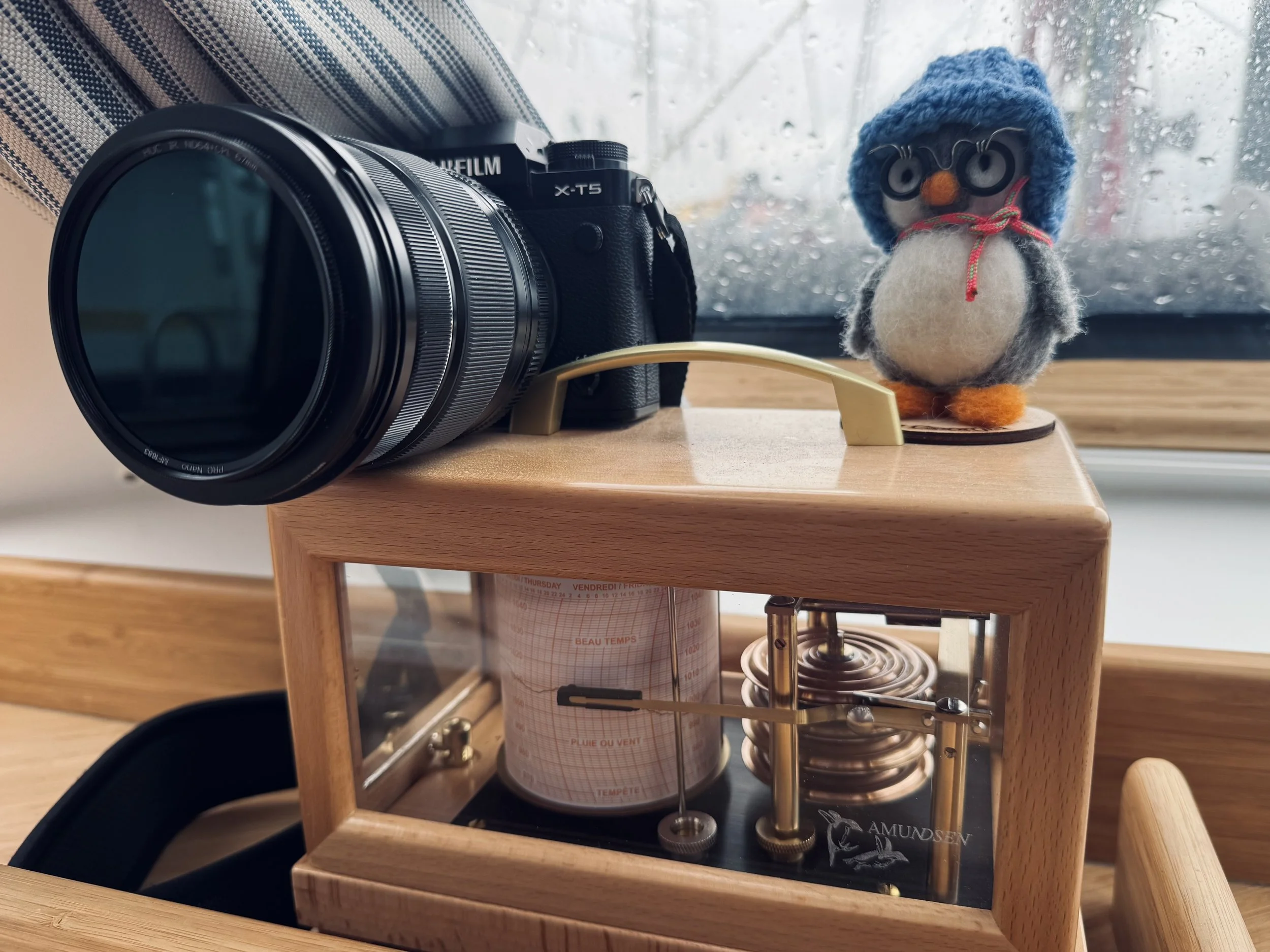
The Barograph in Amundsen’s pilot house is the traditional relic whose popularity peaked with the heyday of whaling: a stack of aneroid cells expanding and contracting with the changes in atmospheric pressure, moving a pen that draws a continuous graph of millibar readings, wrapping around a clockwork-cylinder making one revolution per week. Its prominent position in the pilot house draws attention to data that might otherwise feel antiquated with modern weather forecasting. Still, we pay attention to the rate of change of barometric pressure. “What do you do with all those papers?” Mick asks. I answer that we keep them in the logbook. But actually, I keep thinking about his question, about what they record. Each creating a unique shape, a from:to, that vaguely corresponds with our collective emotions of the week. In the highs, we get our way, we are free to roam and get lost in the activity or the moment. In the lows, all the sounds are heightened, we are on edge, and the plan must adapt to what’s possible. The Barograph is writing tension into time, a rising and falling arc of one metric.
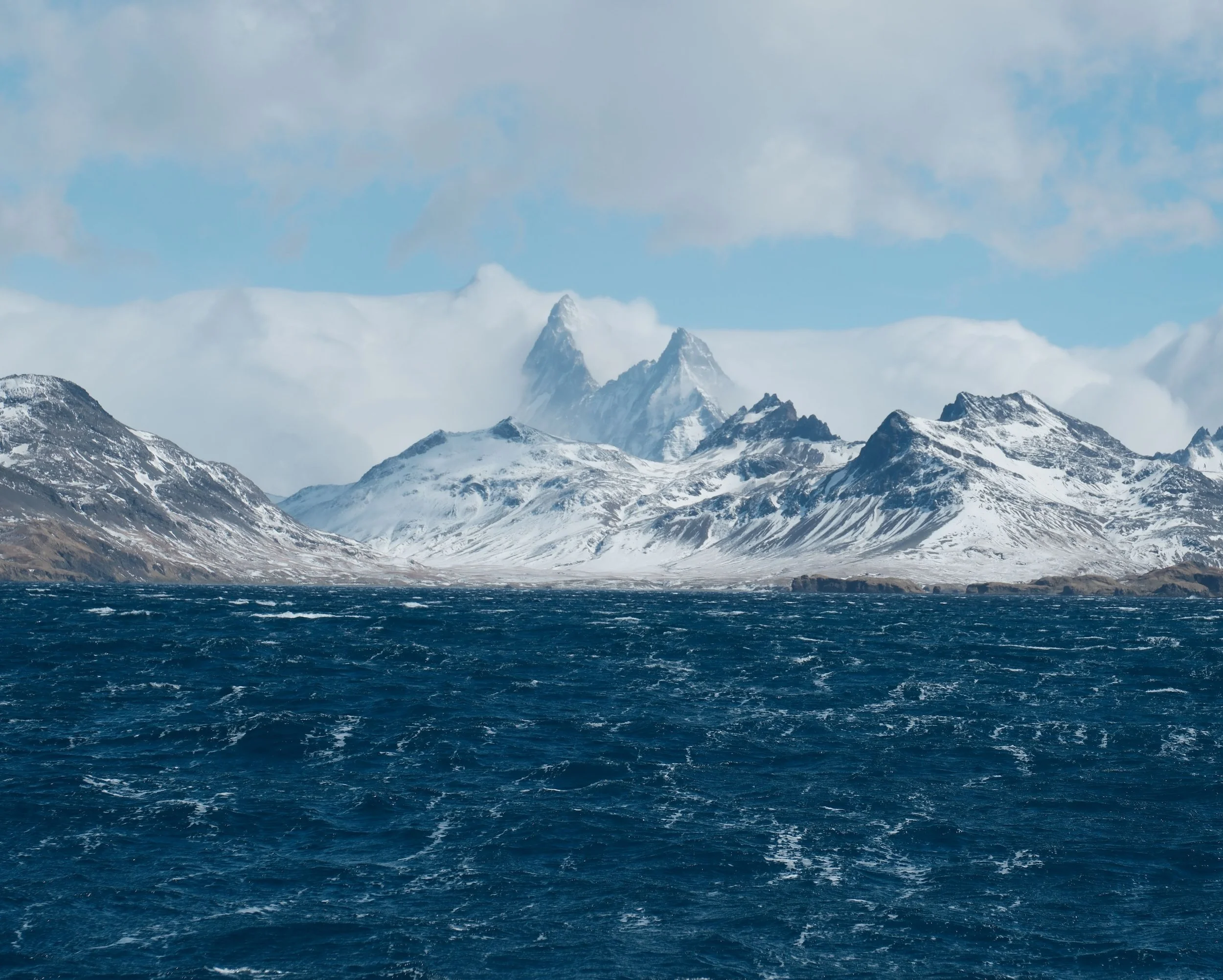
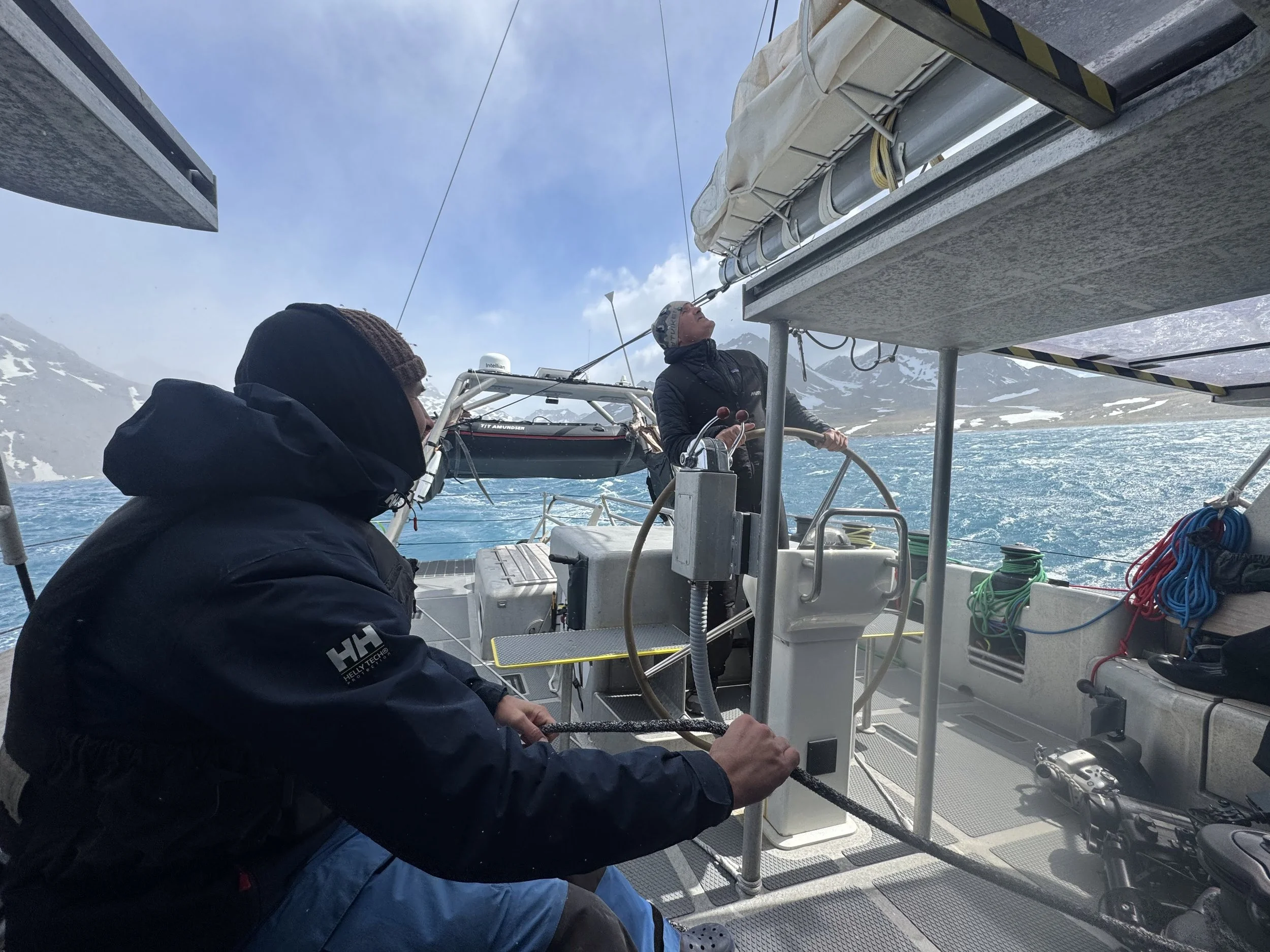
Skipper Justino García-Borreguero hand-steers as Expedition Leader Chris Kobusch eases the sheet in big gusts.
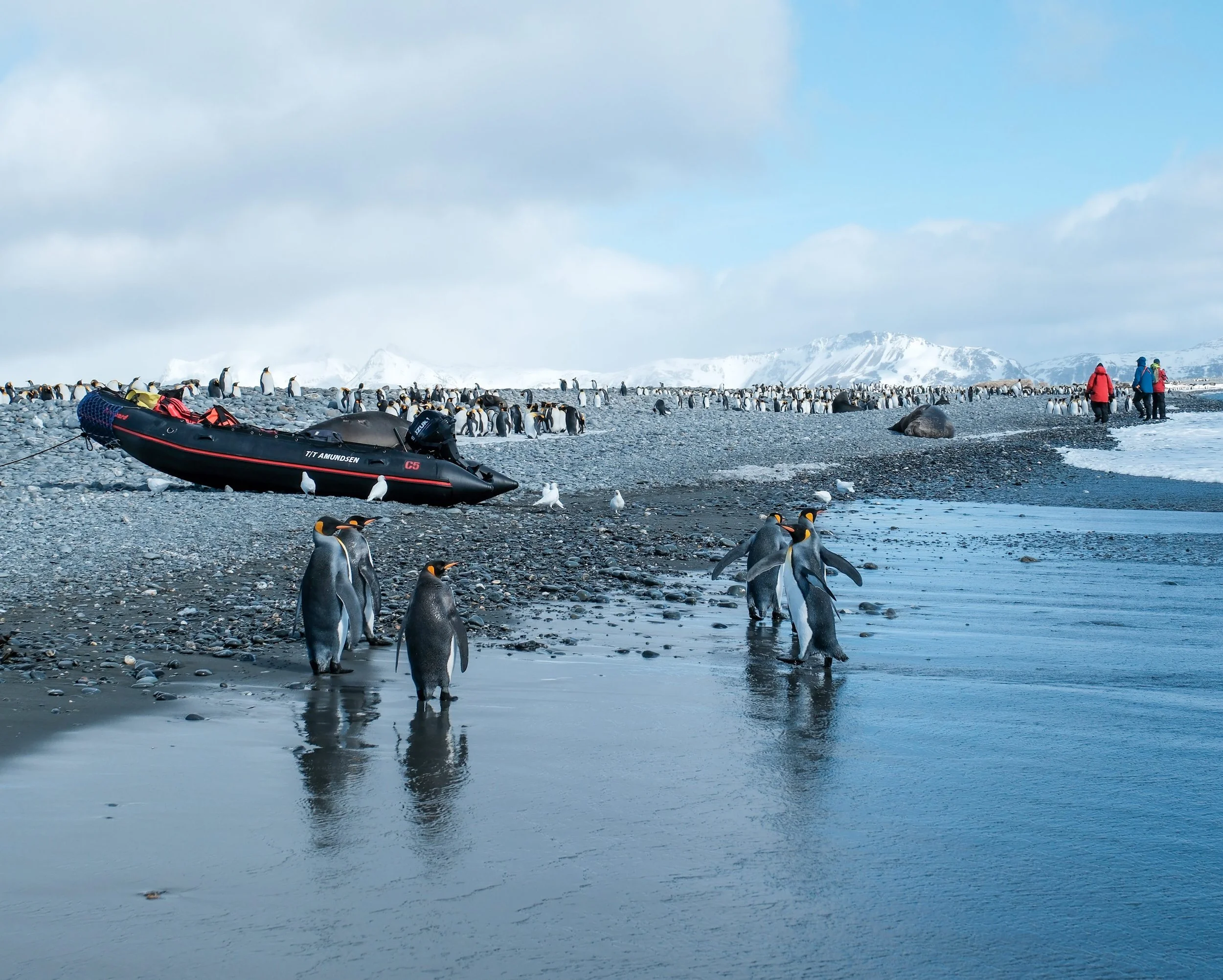
We wait for the squalls to pass, and when the pressure stabilises, we prepare for a shore landing. Boots scrubbed and dipped in saltwater virkon; tripods in fresh. The shore-barrel packed with goods in case of a stranding. A clean tarp between the barrel and the ground. Topped up on petrol, and air in the pontoons. Dinghy spares; anchor and chain. PFDs for all, and radios for the crew. Waders for a bigger surf; at minimum, the impermeable orange Dunlop boots. Two of us perform an assessment, finding a good landing spot, clear of hazards or sleeping seals. One stays ashore, the other runs in everyone and their gear. The shore crew catches the bow of the dinghy, all hop out quickly, we turn the dinghy to face the surf before a wave douses the stern, and then deploy again with a shove, quickly lowering the outboard as soon as the propeller is clear of the ground. Finally we all arrive, and drag the dinghy up the beach, clear of the tide.
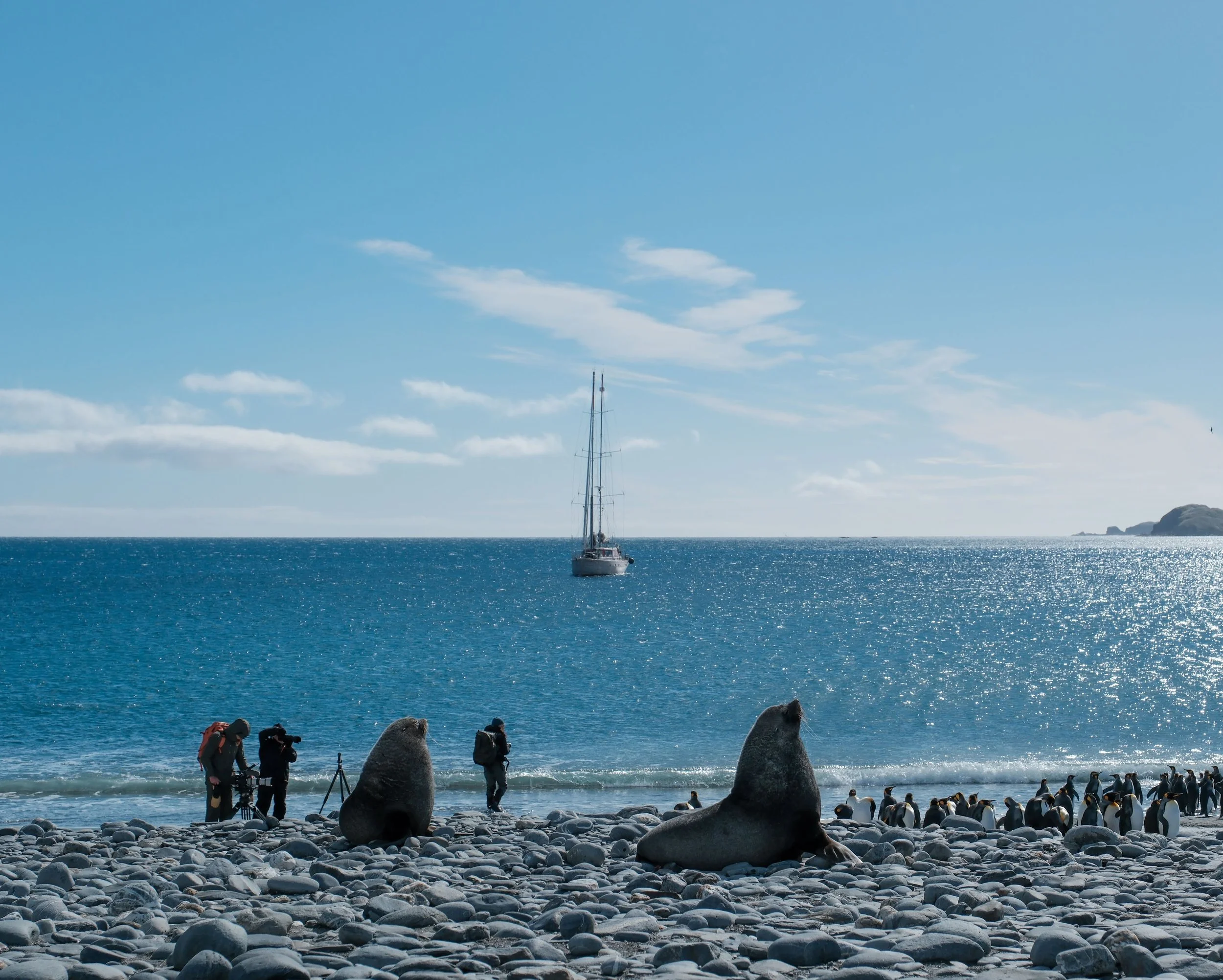
Everyone sets out on their chosen mission. The beach has the most action; on the hills, a greater perspective. There is a close-up intimacy in staying put and observing one place for hours, yet, the tradeoff of lost opportunities walking further for variety.
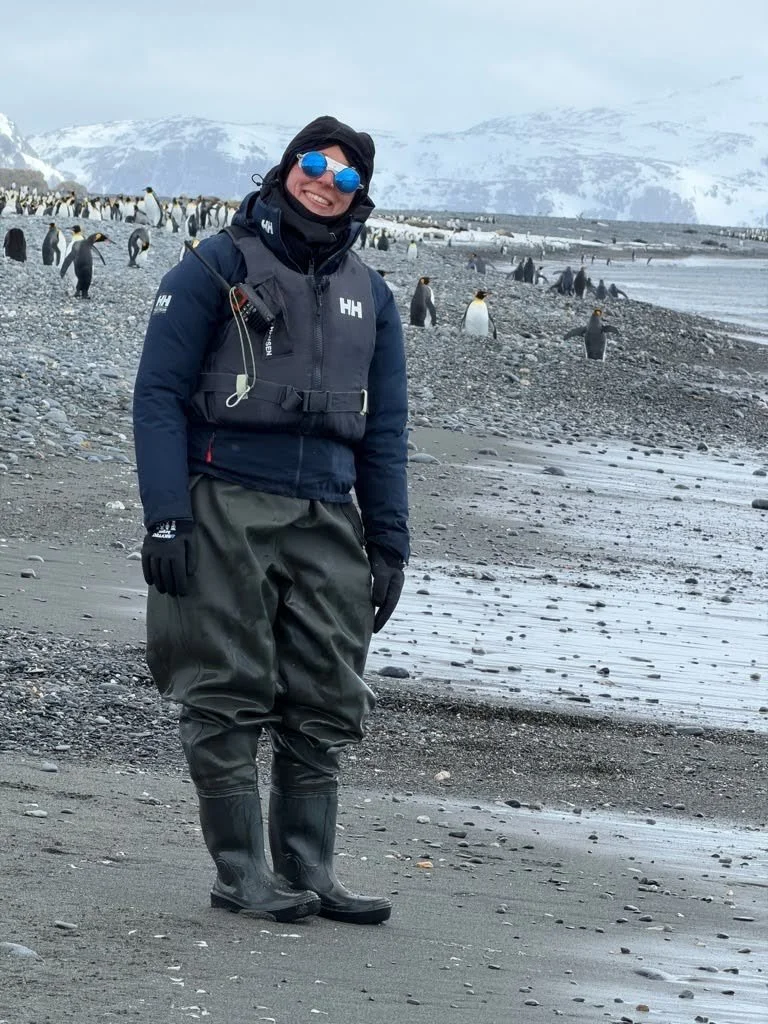
Landing in fashion at Salisbury Plain: oversized waders, balaclava and glacier glasses to keep out the wind (photo credit: Emry Oxford)
Through the raw clay of experience, we raise our Cameras, snap-snap, and begin to capture moulds of light. Penguins and mountains. A group of penguins doing the same thing. Penguins as far as the eye can see. Penguins coming and going from the water. As soon as we look through the Camera, we ignore everything else, and record this singular instance, extracting it from its context in order to transmit an emotional impression to a viewer faraway. The Camera creates characters. Expressive faces. One brave penguin ahead of the crowd. Hesitation. Motion. Gestures. Struggle. Resilience. Camaraderie. Janelle describes: “I’ve taken so many photos, that now I look for the stories.”
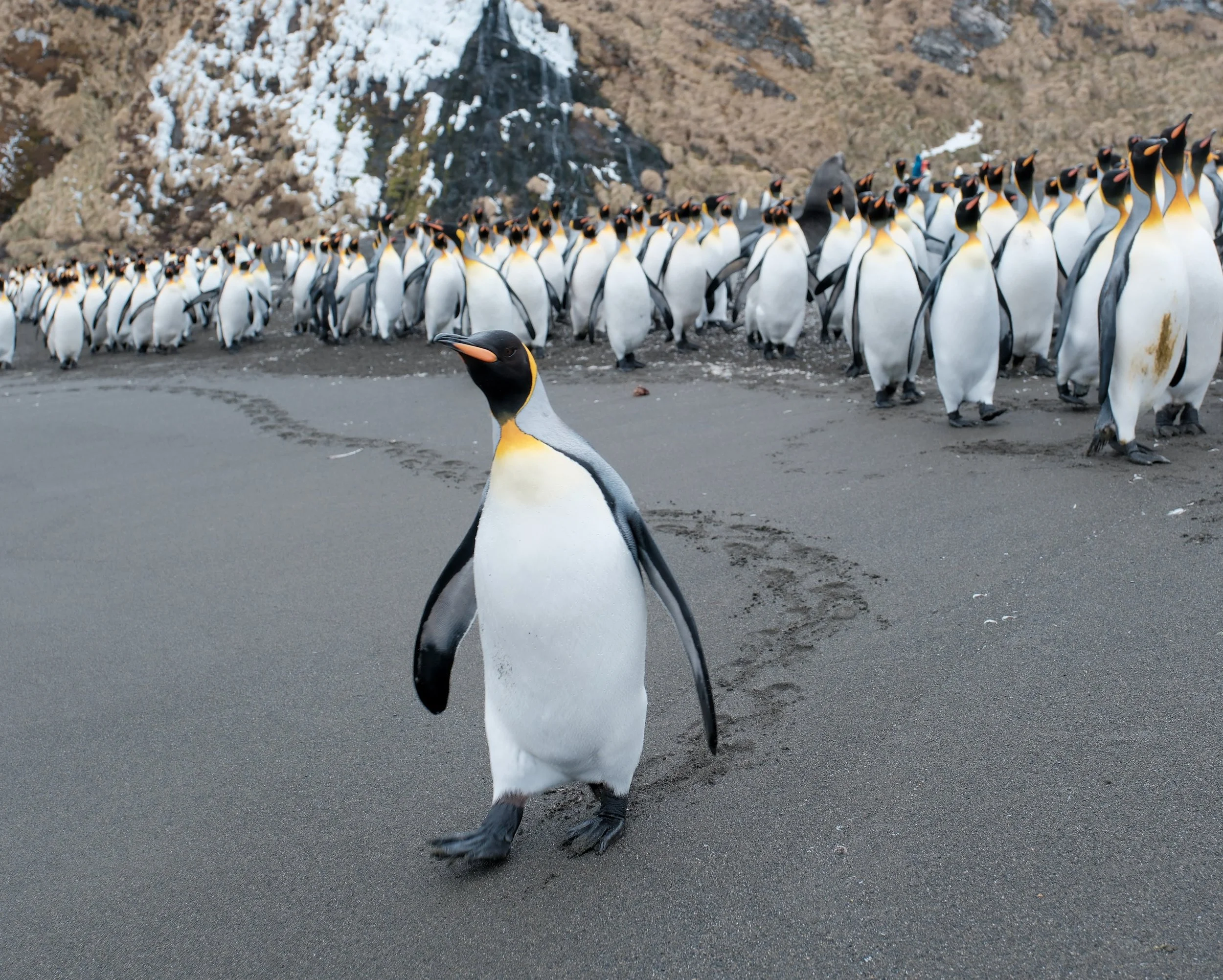
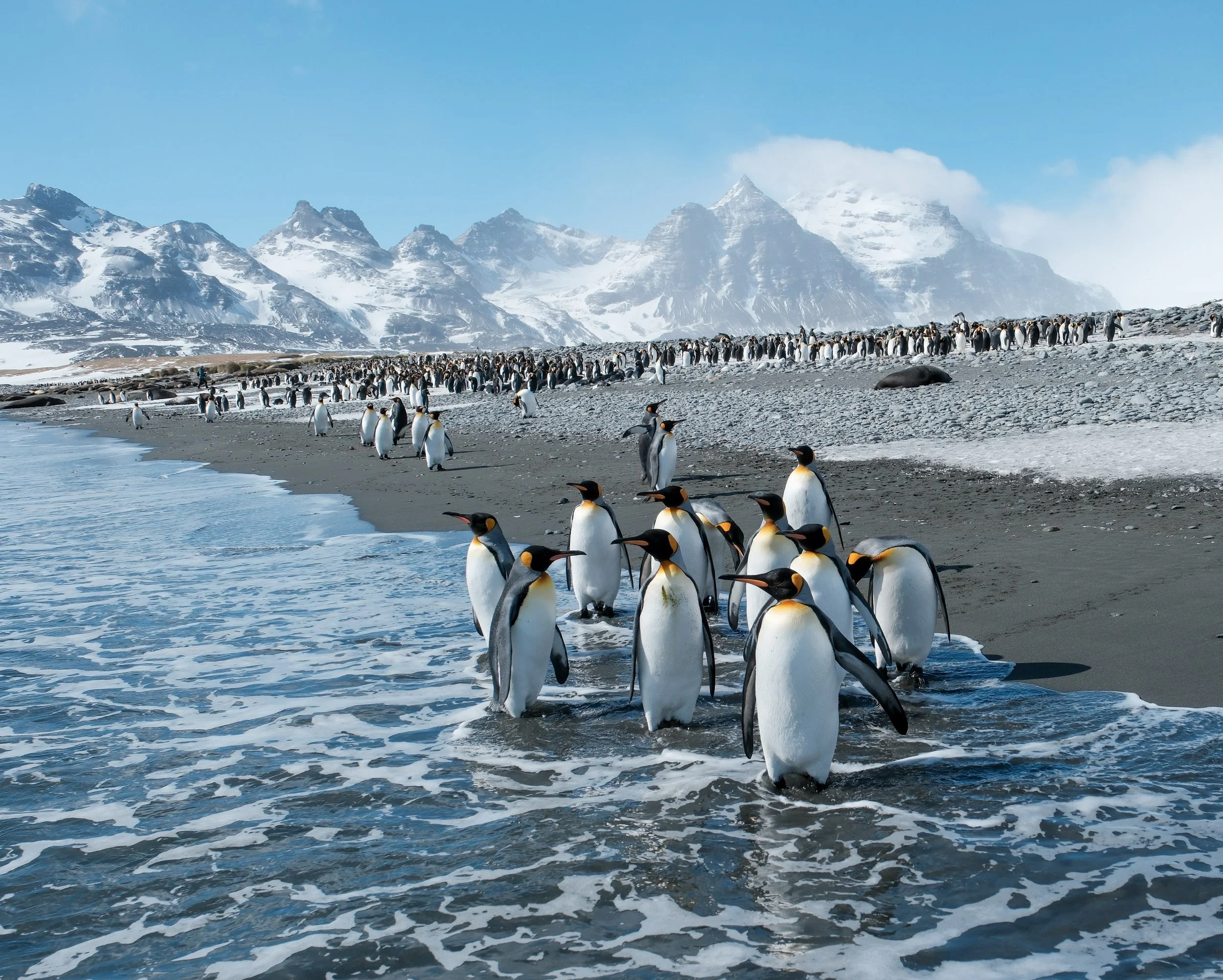
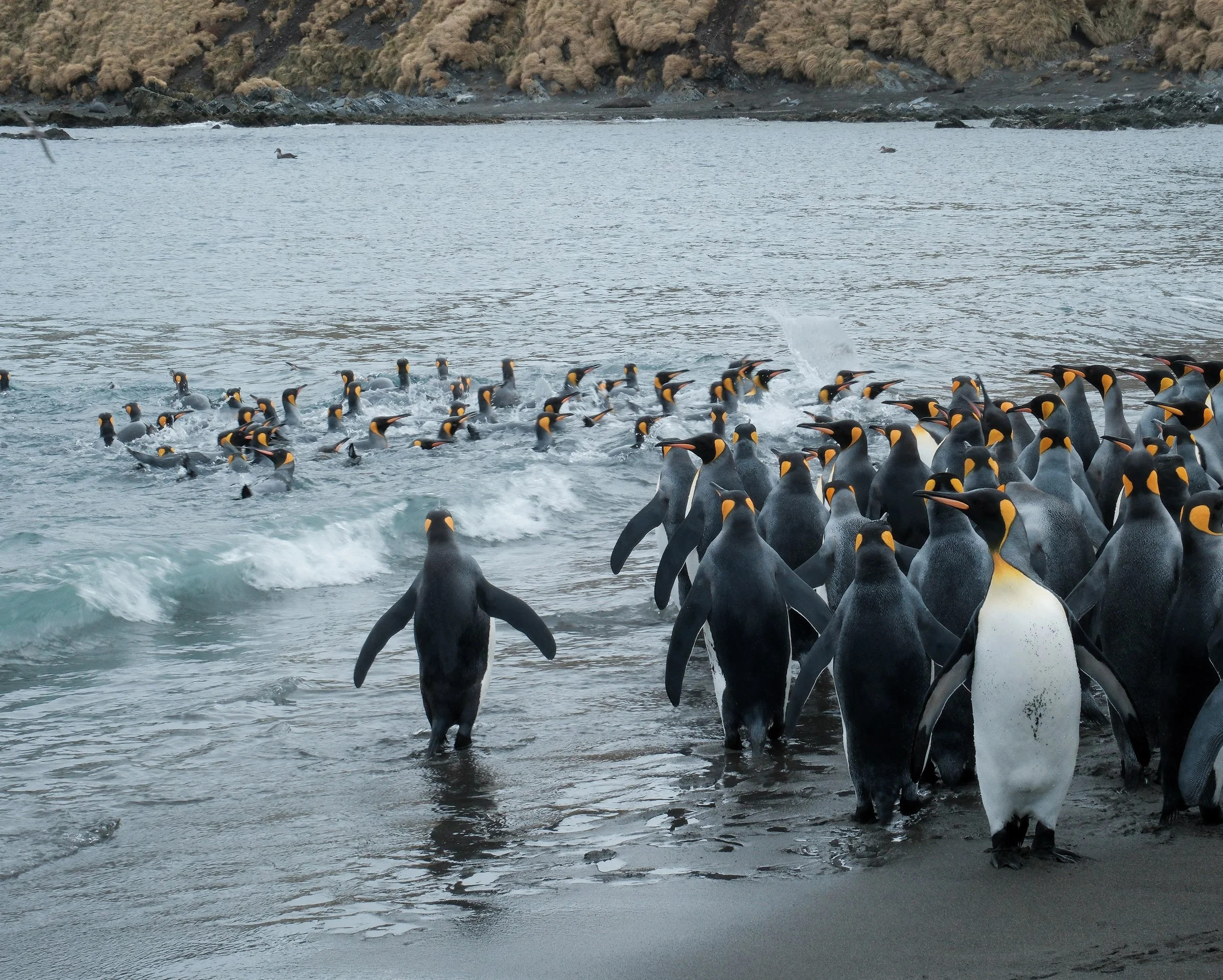
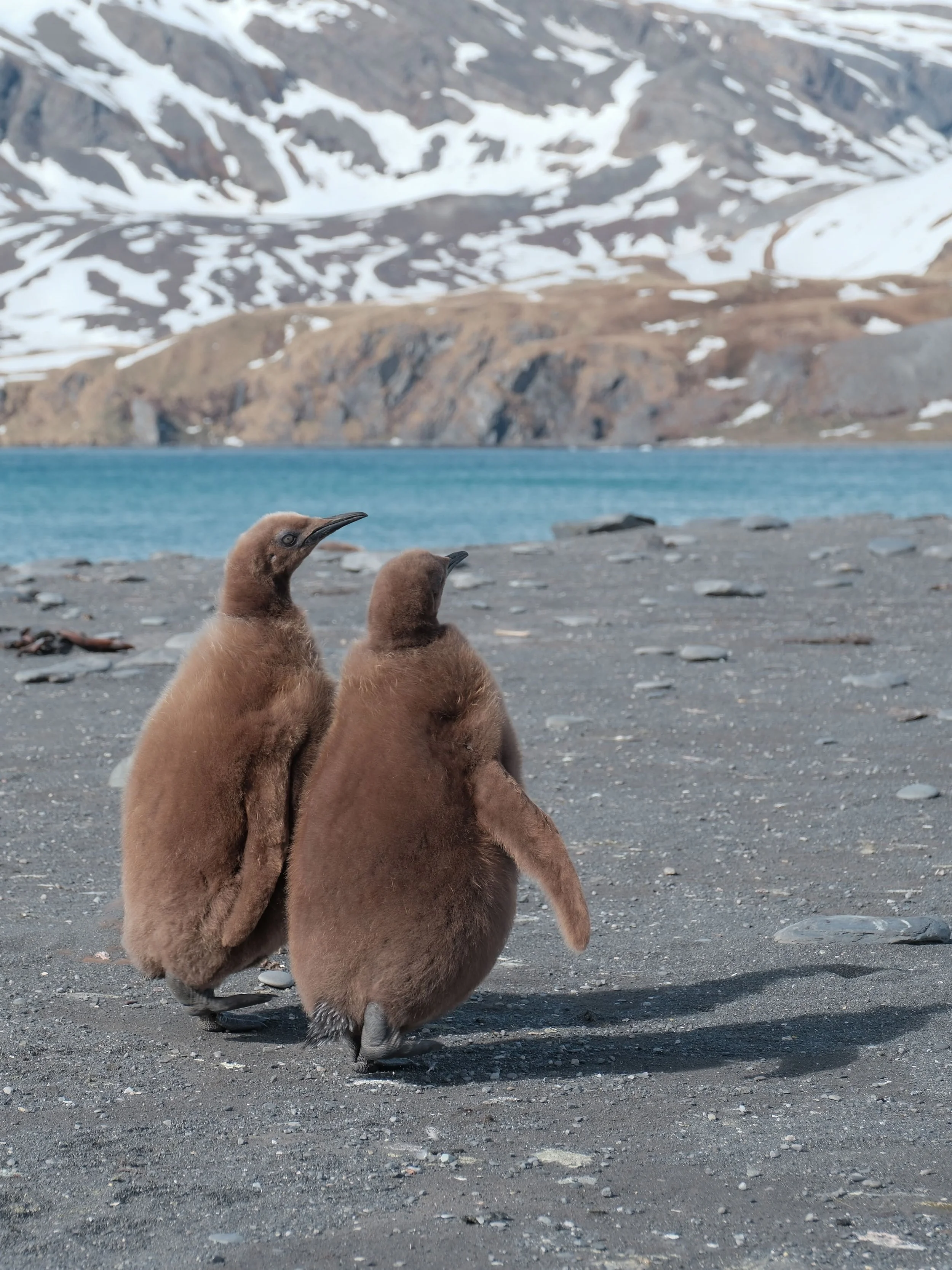
Expressive penguins: Right Whale Bay, Salisbury Plain and Gold Harbour
While one can wax poetic about those birds who’ve traded flight to swim like fish, let me instead turn the attention to one of indomitable character: the snowy sheathbill. As soon as we let run the chain and the anchor bites the seabed of a new anchorage, the flock descends, with particular intrigue in the gantry and the icelight. They begin pecking morse code messages on the Starlink antenna. TAP TAP. Tip tip. TAP tip. Tip. Trying to intimidate them has little effect, they hover and land immediately. Other birds seem to disdain them, with both penguins and snow petrels scolding them in passing. Several mornings I spend hours scrubbing the deck of sheathbill excrement and pouring bucket after bucket of water. I spotted one sheathbill with a leg band at Salisbury Plain, and came to learn that the British Antarctic Survey is conducting important research on sheathbills, “the species that has taken the spotlight this year – as little is known about their population size, migratory movements, or behaviours… The birds are already revealing themselves to be willing travellers.” We have one data point to add: the only aversion of theirs we could find was the colour orange.
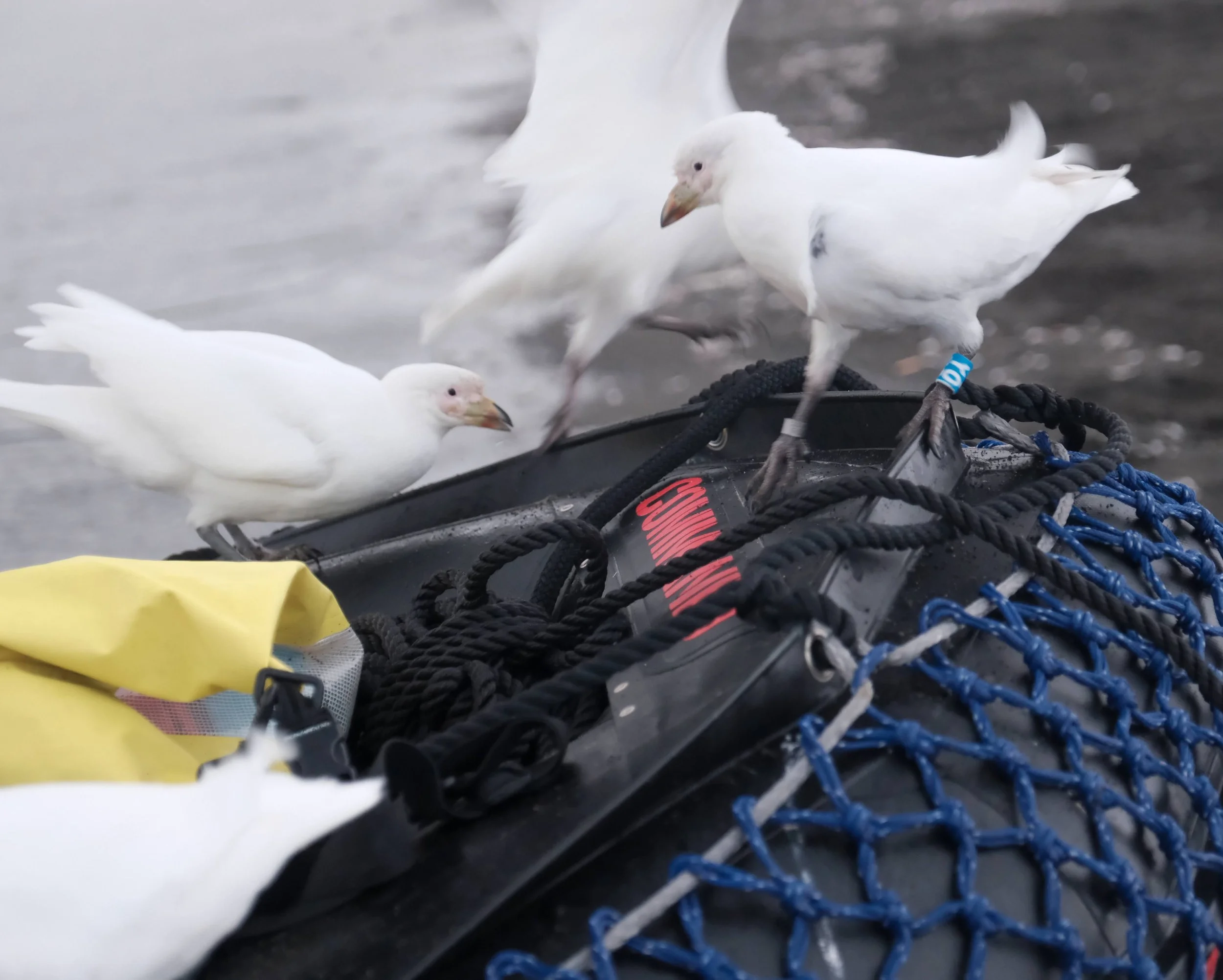
Sheathbill “YO” and compatriots overtake the dinghy at Right Whale Bay
The deep mysteries of sheathbill society, masked by the fearless mundanity of the white chicken, have gotten me thinking that the best story-photos must leave something out, a void for the viewer to inhabit. This is the way of a good book’s protagonist, the reader stepping into their perspective to record wisdom from their experience: feeling their ups and downs to understand how their motive drives their behaviour. Why does the elephant seal rest now? Because he will joust for his life later.
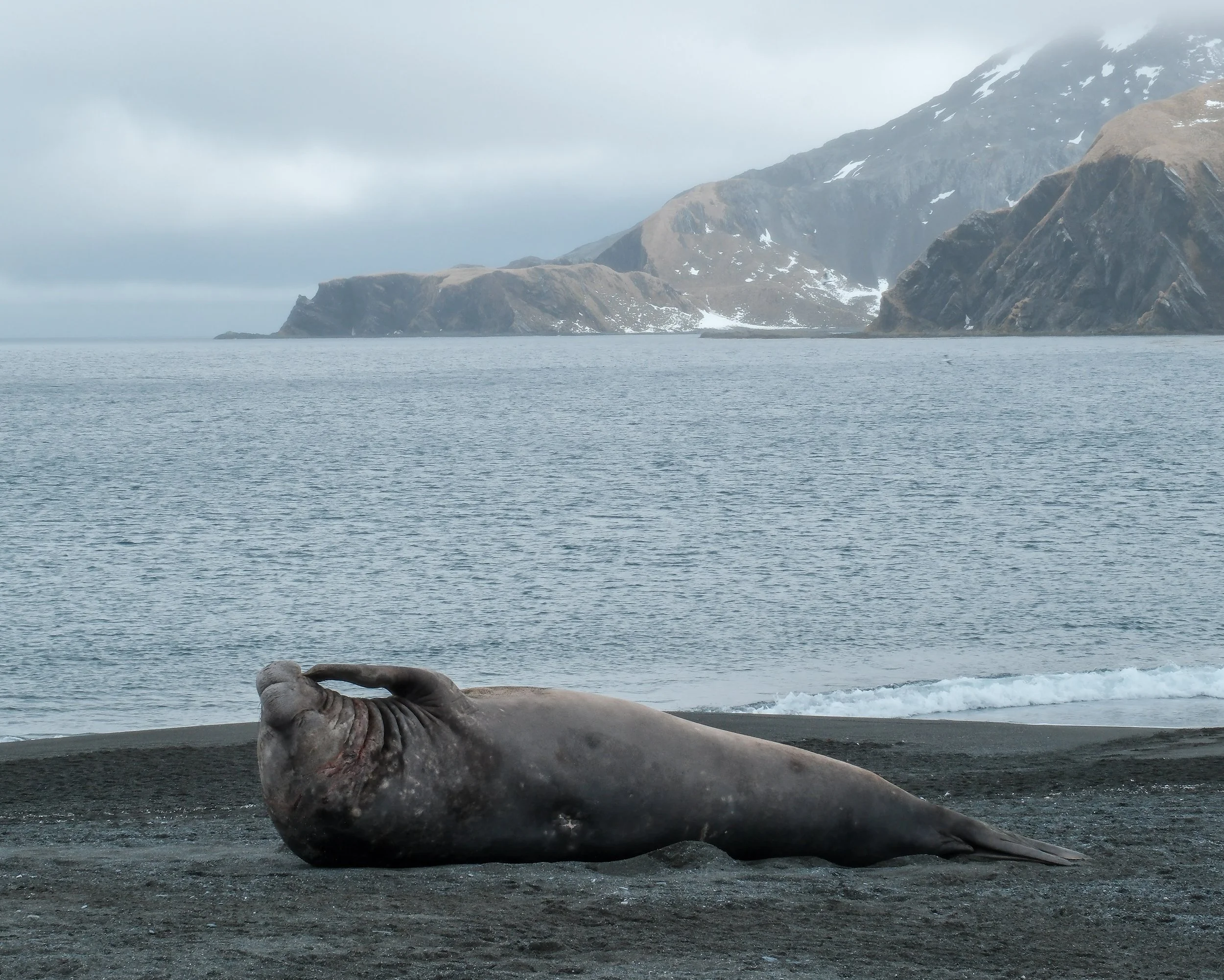
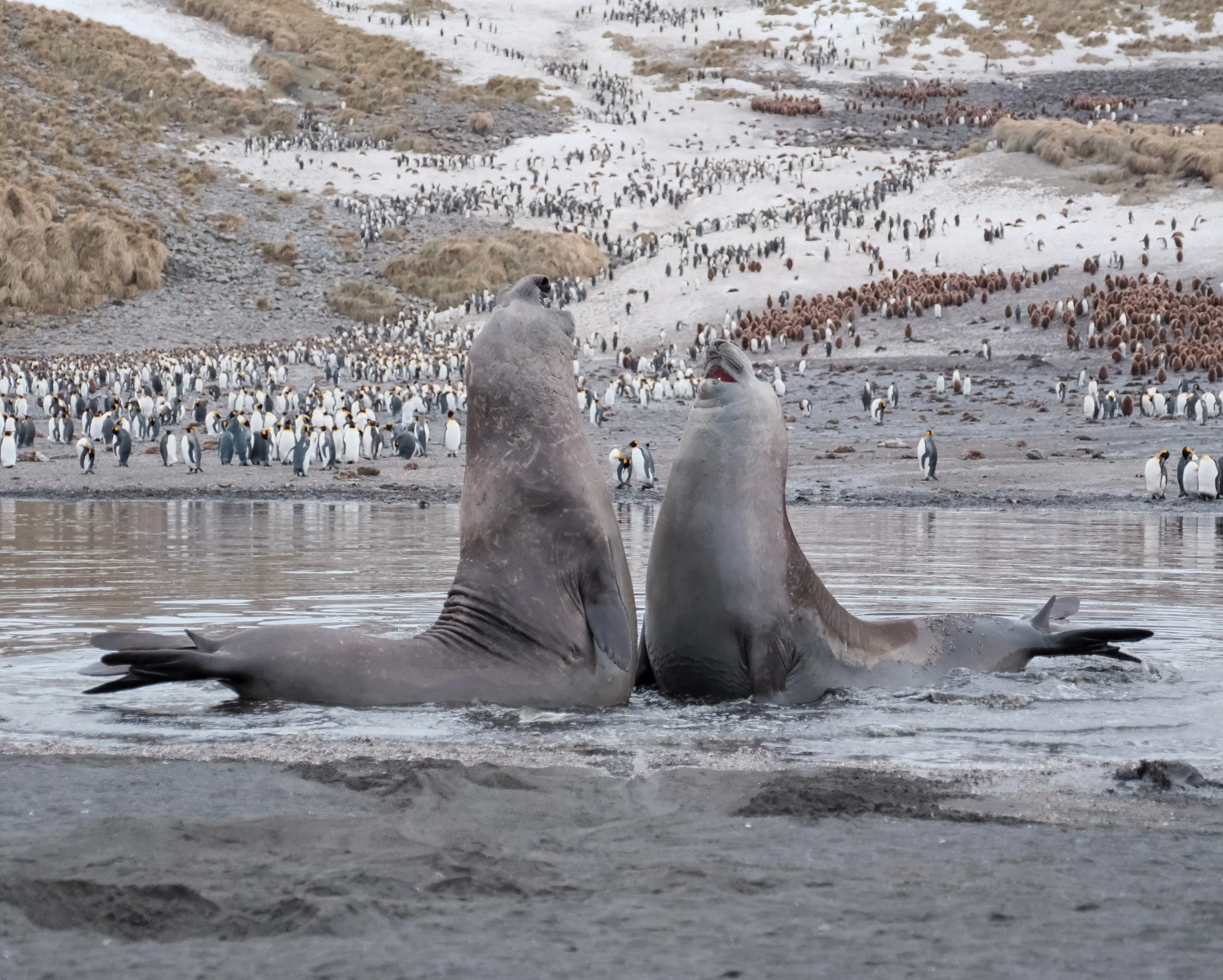
The South Georgia protagonist who’s surely most gripped the public imagination is Ernest Shackleton and a few of his crew, who after the loss of the Endurance, sailed 16 days from Elephant Island to King Haakon Bay, and found their way over glaciers to Stromness, mounting a rescue for the men awaiting their return. Joe shared with us his deep knowledge on the subject, having traced their footsteps on the Shackleton Traverse a few years prior. He noted that photographer Frank Hurley doctored several of the photos to layer scenes or portray events differently. An interesting analysis describes one instance where: “Hurley had not captured the actual rescue, and he [used a photo of the James Caird’s departure] to tie up the narrative… I can’t seem to forgive him, because when I see a photo like this I scan it for the smallest details so that I can learn more about life. I squint to make out any expression on the faces, the postures of the people. How is it that starving, half-dead men actually respond to the arrival of help? They seem to get a super-human burst of energy and start waving their arms about and jumping. I make all kinds of inferences and store the information away.”
As tellers of stories, as photographers, it is our responsibility to portray some experiential truth. But from what baseline can we measure that truth when the Camera is a subjective instrument? The Barograph records nothing but the blunt truth, and yet it takes a great imagination to feel fear, wonder, solace or love when you read its prints. South Georgia changes our sense of abundance, compared to the landscapes most of us inhabit at home, yet her abundance is fragile. South Georgia changes our sense of adventure, as we cannot know whether an outing will be fruitful or not based on the look of the anchorage or the current mood of weather. And, South Georgia changes our sense of justice, showing that the bounty of prolific living can only exist from the eating of others.
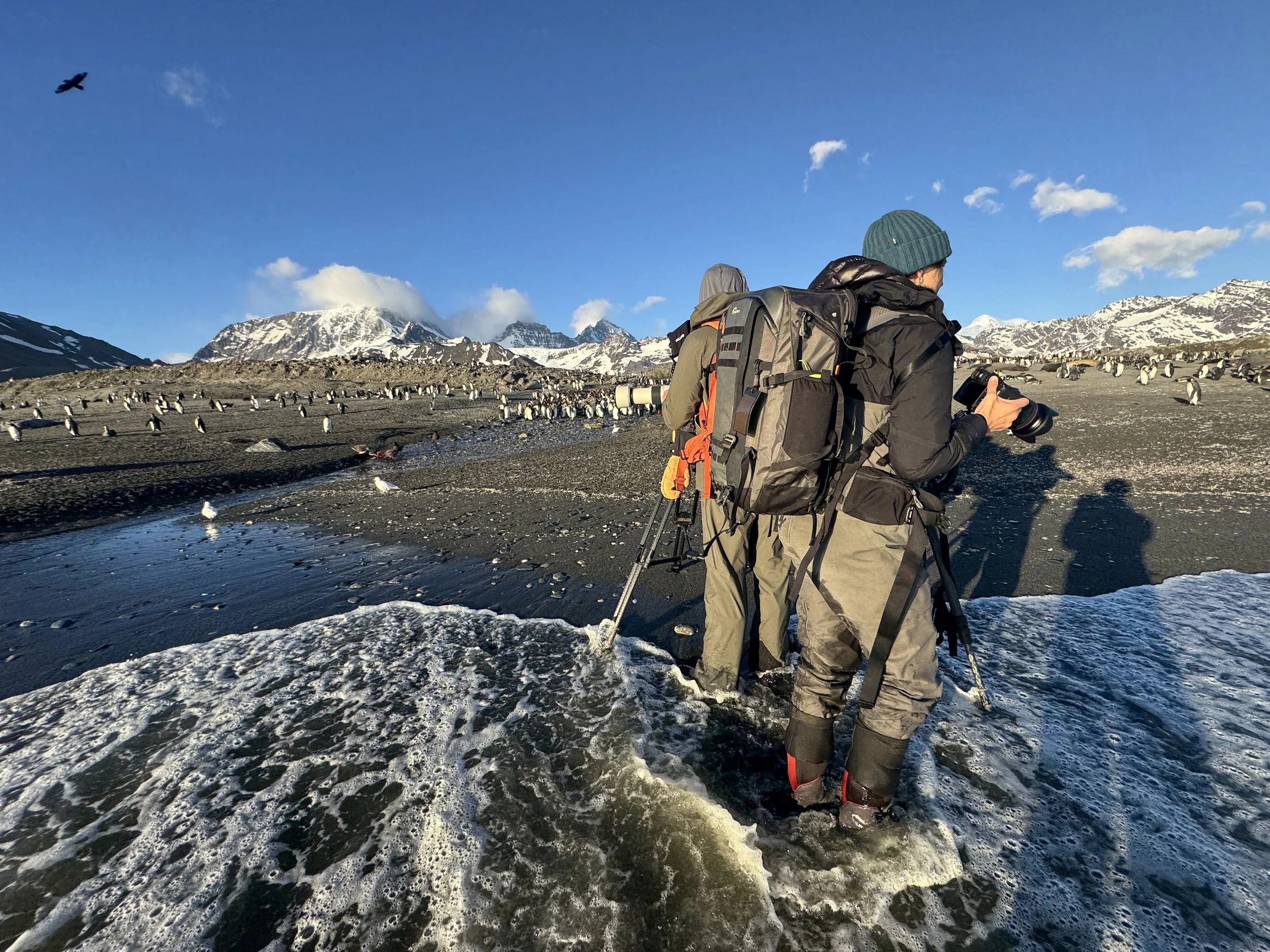
Kyle Roepke and Nicki Pollack deep in their craft at St Andrew’s Bay
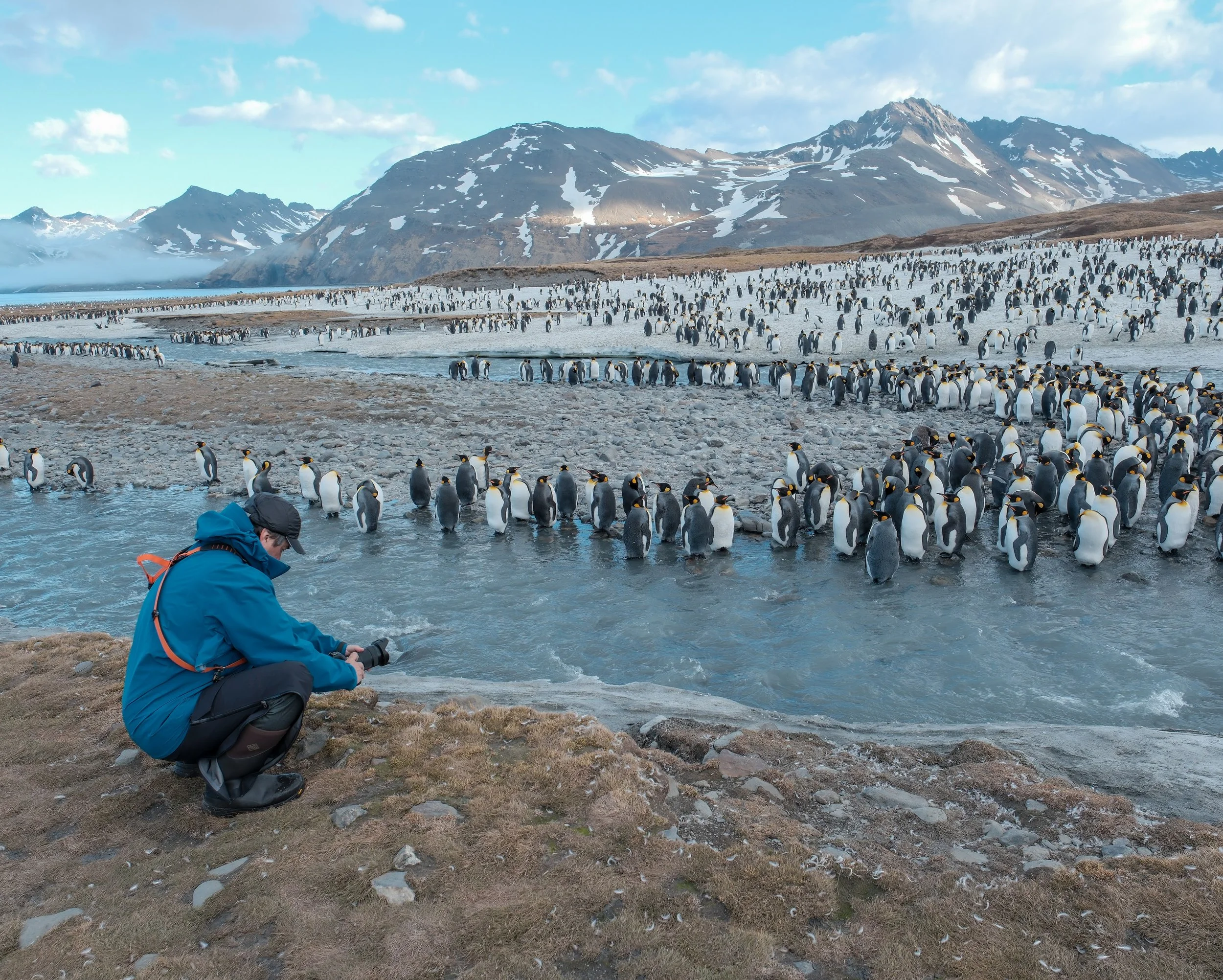
Bill Ewing documenting a river of penguins
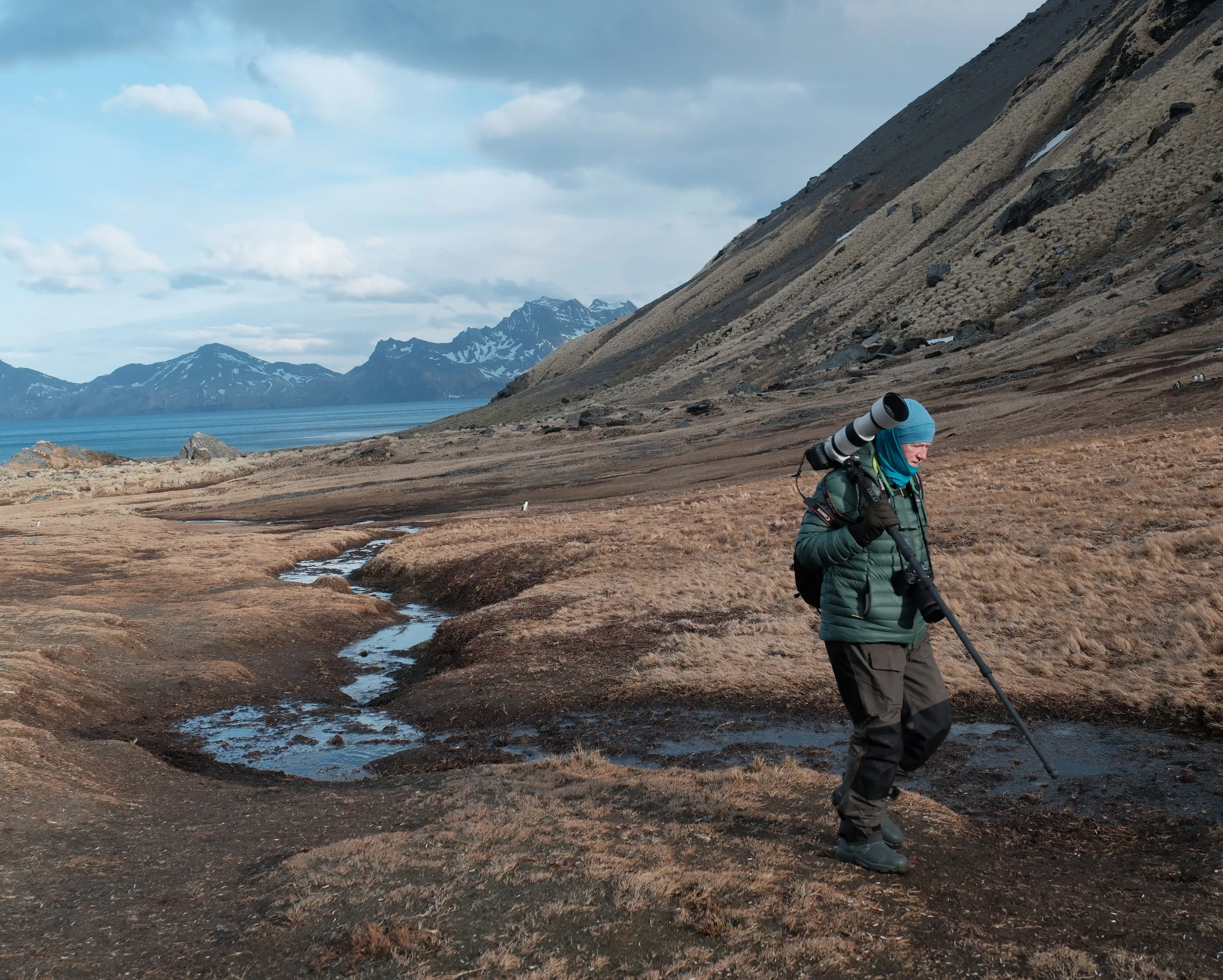
Joe O’Dea trekking with his tripod at Moltke Harbour
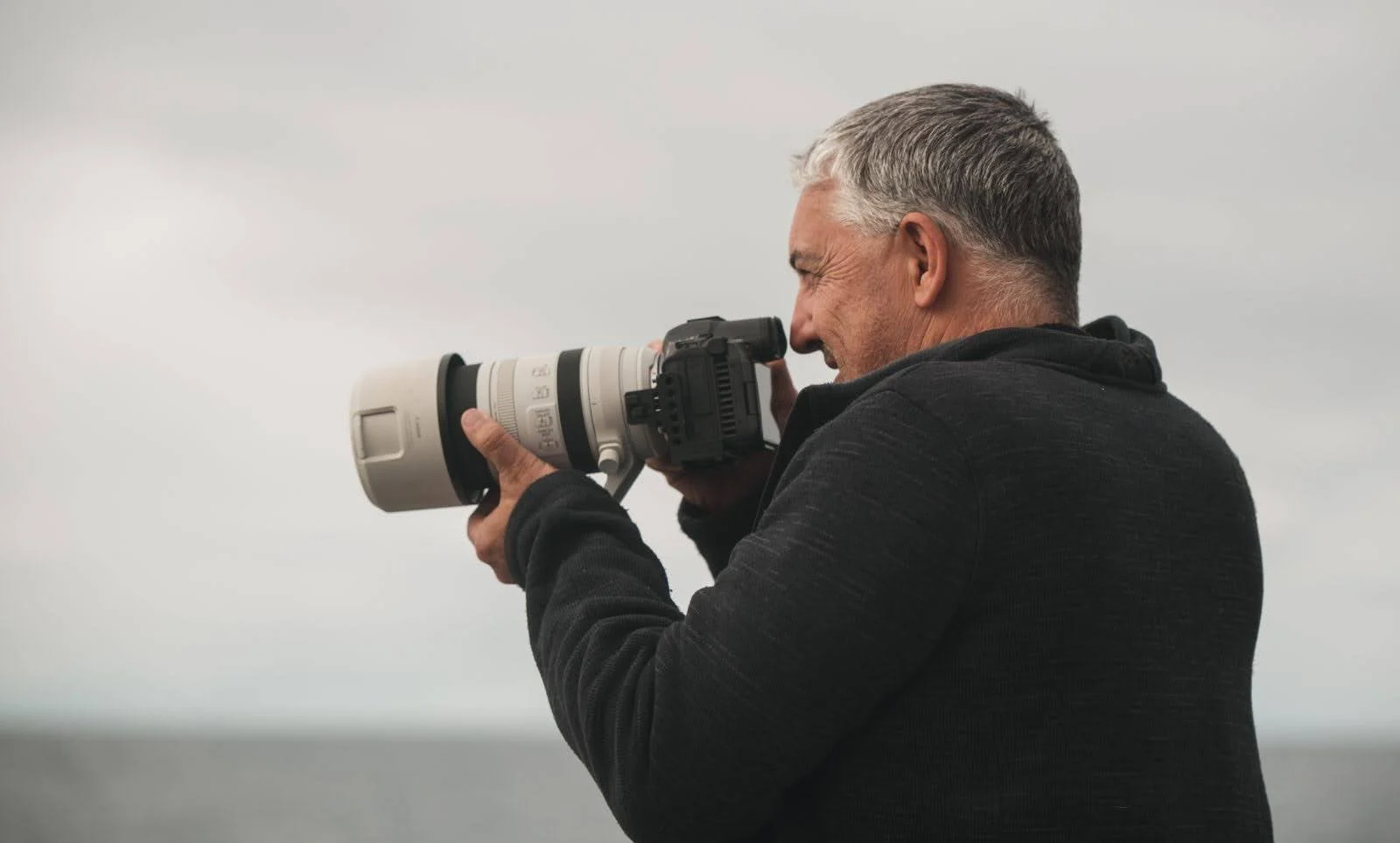
Lead Photographer Scott Portelli behind the lens at sea (photo credit: Chris Kobusch)
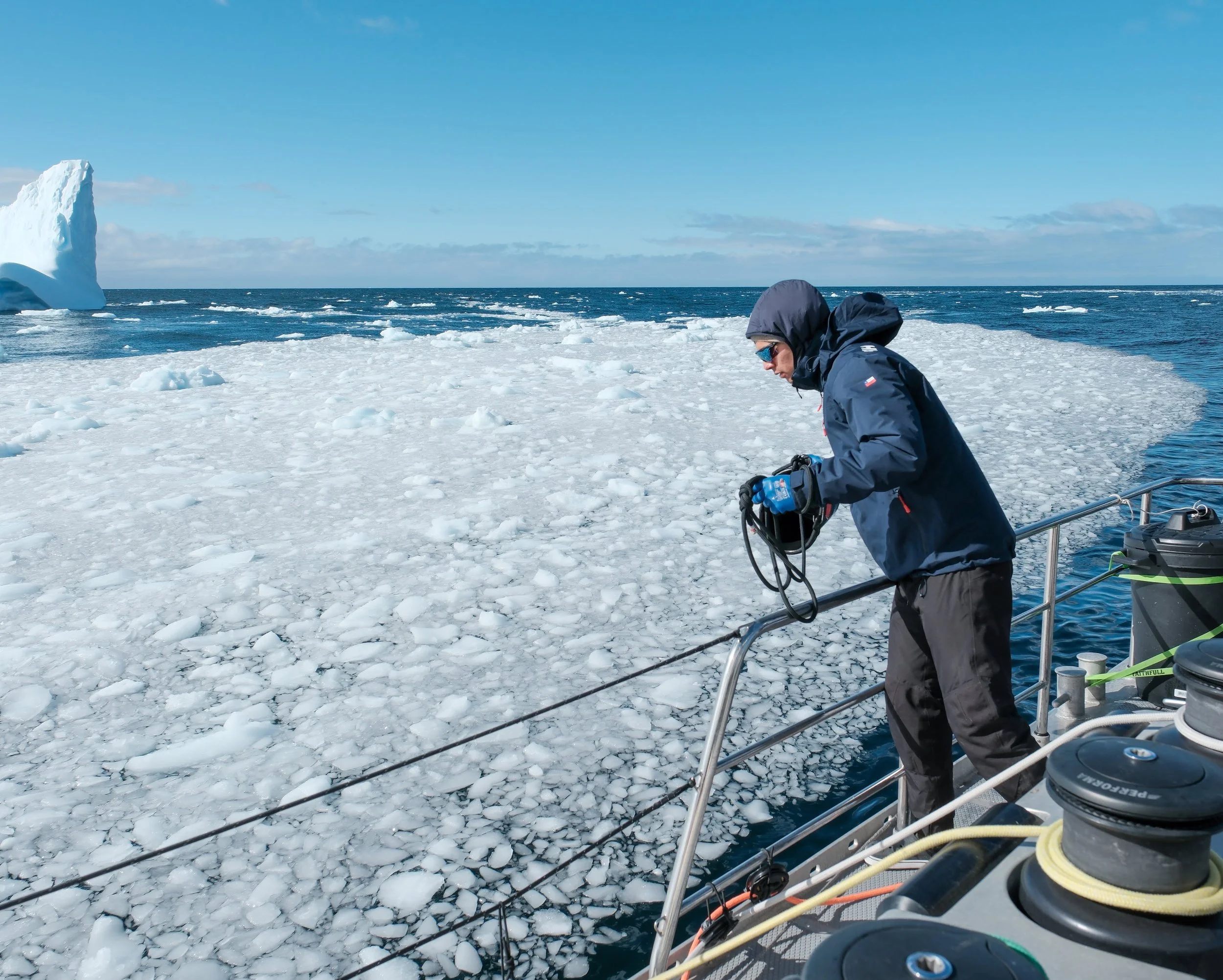
Deckhand Arturo Oyarzun gathers brash ice from a passing iceberg for millennial gin & tonics (in my case: “& tonics”)
With so much activity around us, it’s tempting to try to over-plan a route through the chaos to a specific story. In order to take the perfect shot, you need to be ready before the moment occurs. The mind is a prediction engine trying to fill in what will happen next, or trying to bend reality to its will. Our first morning in St Andrew’s Bay is a beautiful sunrise that we take almost for granted that it’s like this often enough, that we can continue building on the same visuals. We move our clocks forward to wake up at 5am instead of 4am for the next sunrise. Yet, every subsequent attempt to wake up early is met with fog or thick clouds. The Barograph can tell us about the weather, but only the Camera can judge the light.
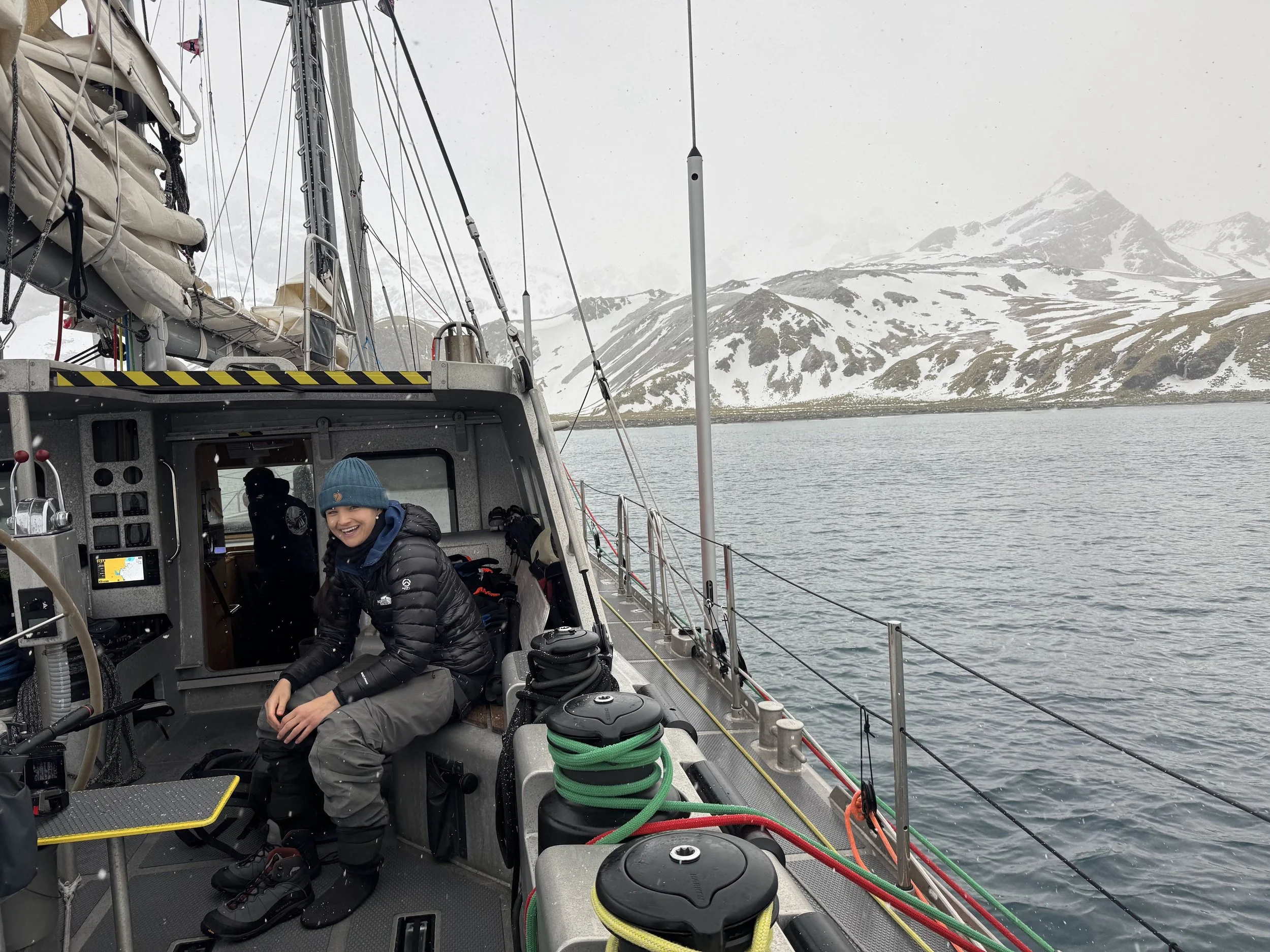
Nicki Pollack gearing up for a snowy, cloudy landing
We have good intel on a macaroni penguin colony at Rookery Point, up the hill from Cobbler’s Cove. We set out with the enthusiasm of a well-rested morning with a clear quest that seems to have odds stacked in our favour, worth hauling camera gear against gravity. Chris leads the front of the group, and I take up the caboose. As we crest the ridge, most of the group descend onto the rookery, but Kyle has spotted a few blows in the distance and decides to deploy the drone. Six kilometres out to sea. I hang back to assist. We feel torn knowing that the group is going to want to spend time with the coveted macaronis, but we are observing something extraordinary, and Kyle risks his drone to its limit, dodging one attack from an angry tern, and returning it to land alongside us with 3% battery. Over the VHF Chris calls: “Could you please fly the drone to scout for the macaroni colony? They are not here.” And Kyle replies: “The drone is currently busy with HUNDREDS OF WHALES and THOUSANDS OF PENGUINS AND FUR SEALS.” Abandoning the absent macaronis, the group returns and we hasten back to Amundsen to gear up for snorkelling.
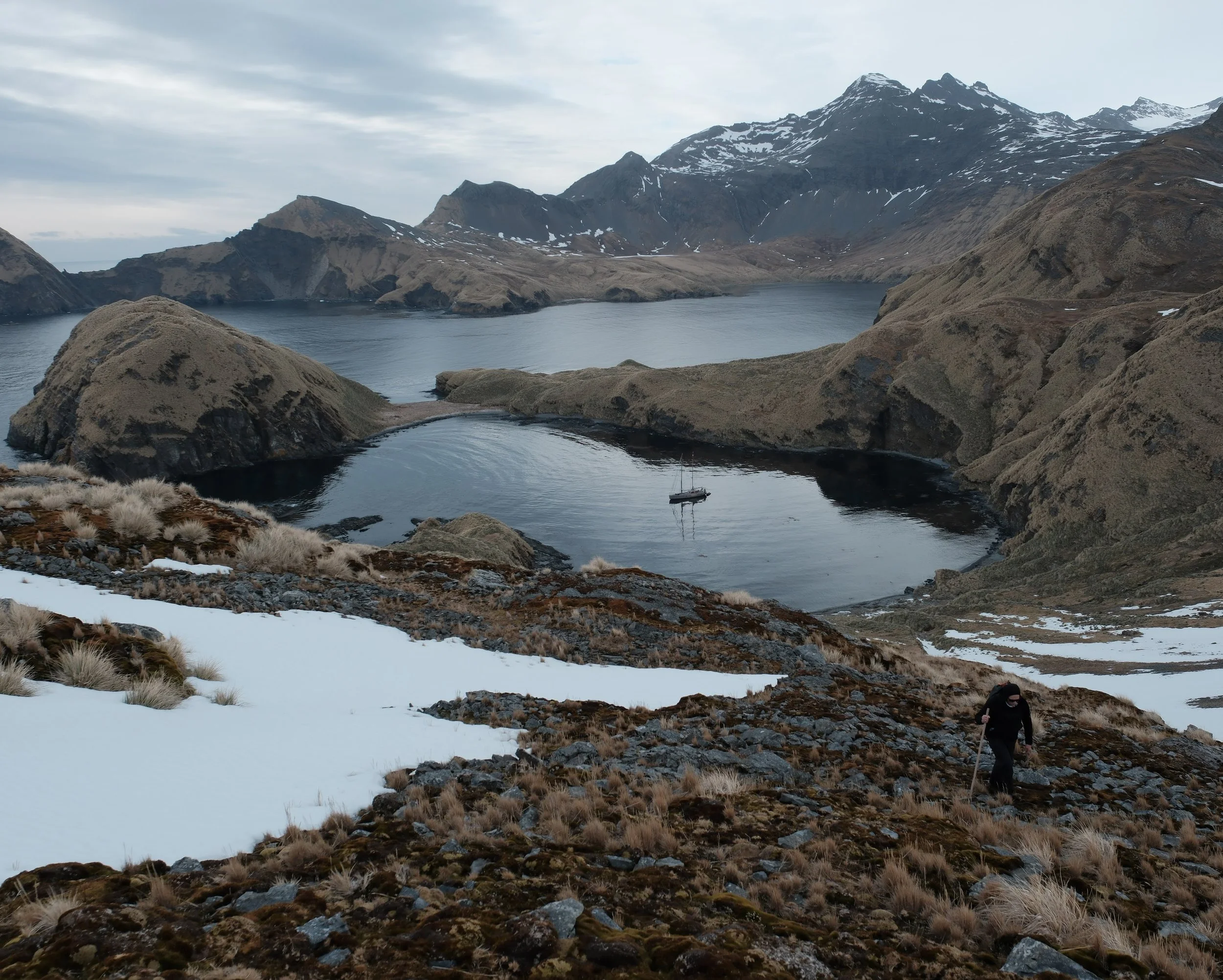
Emry Oxford climbs above Cobbler’s Cove
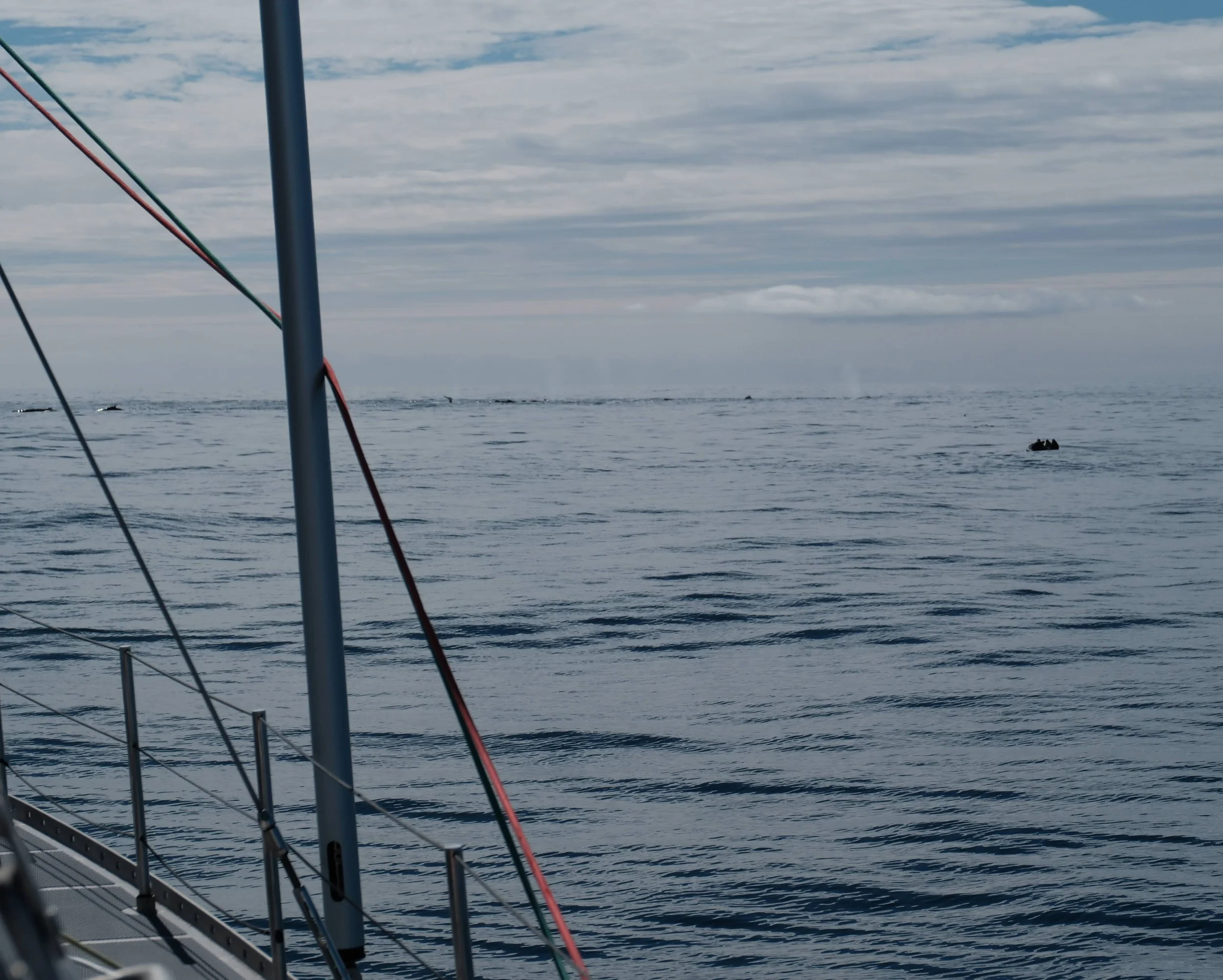
A speck of dinghy in the open sea nearing Whale City
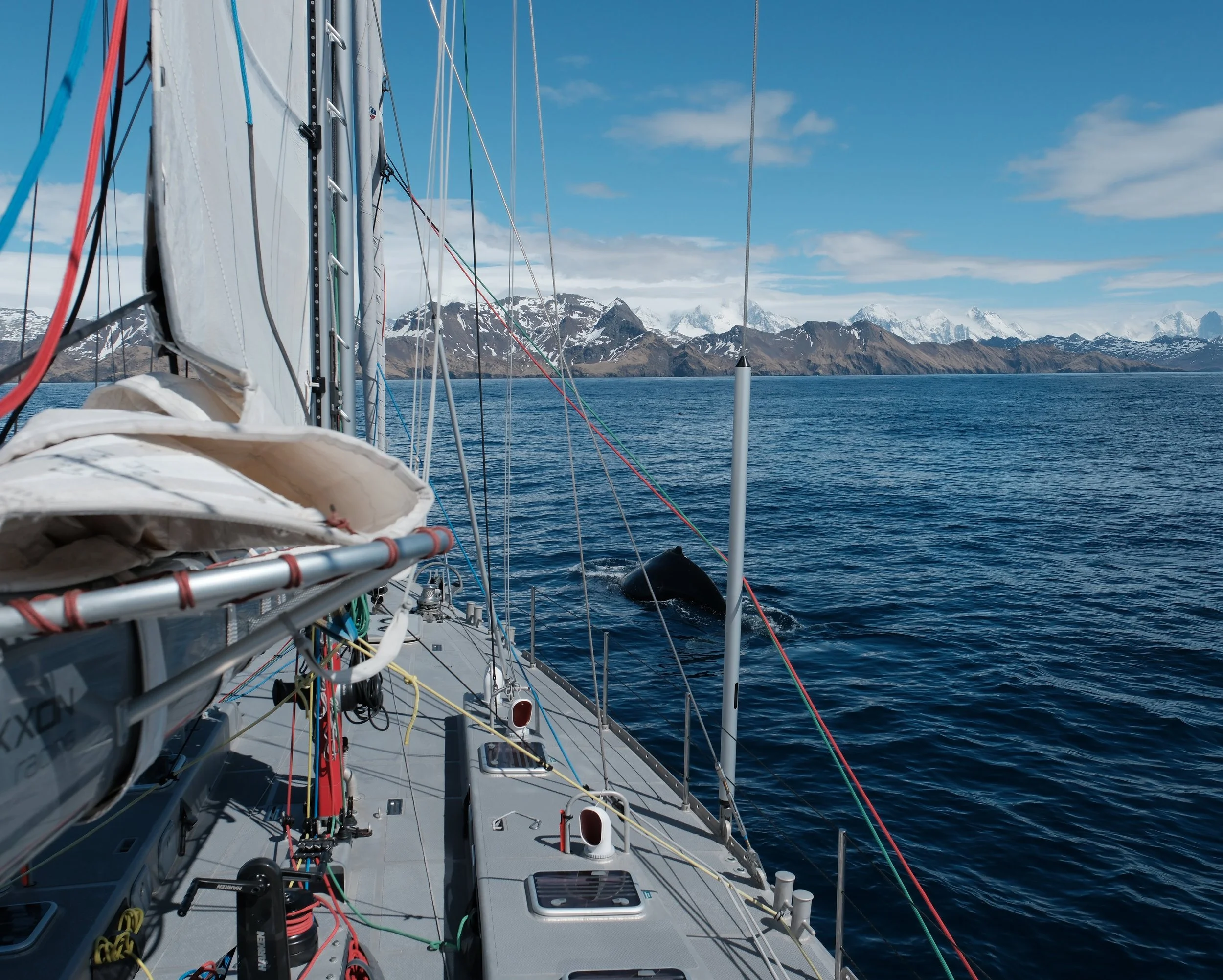
Humpbacks swim by as Amundsen bobs under a foresail’s second reef
Chris writes to penguinologist Tom Hart, whose cameras were found at the empty rookery. He sends us a graph of macaroni statistics, a line of data we could have read to save our climb up the hill. We learn that they typically arrive en masse on the first of November, and not before. We will miss them by a few days. Yet, if it weren’t for the search, we would never have followed the breadcrumbs leading to the extraordinary gathering of whales that for many was the peak experience of the trip.
The question now is, what do we do with all these photos? Hundreds of thousands, collectively. Our individual lenses searching for stories, lost fragments unless we take the time to shape and tell them to others. Stitching together the light-moulds and the barograph-traces to make our own meaning. And then there is the void we must inhabit, hidden from both instruments: the macaroni penguins and the leopard seal that we did not see. They remain a magnetic pull of curiosity that keeps our minds reaching back for South Georgia no matter how far we stray.
Words and photos by Kate Schnippering except where other credits given
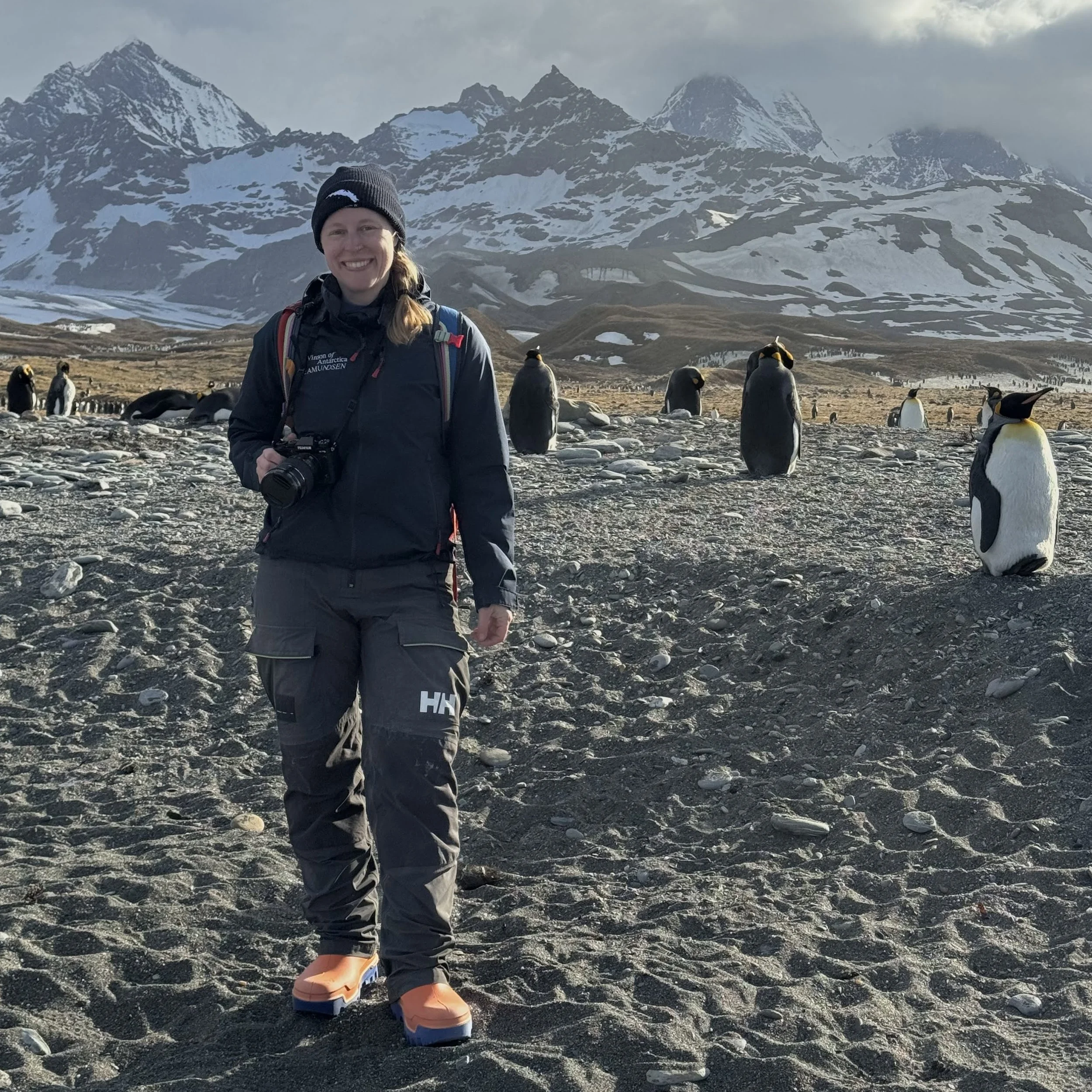
Kate Schnippering
Amundsen’s crew
